


 New York
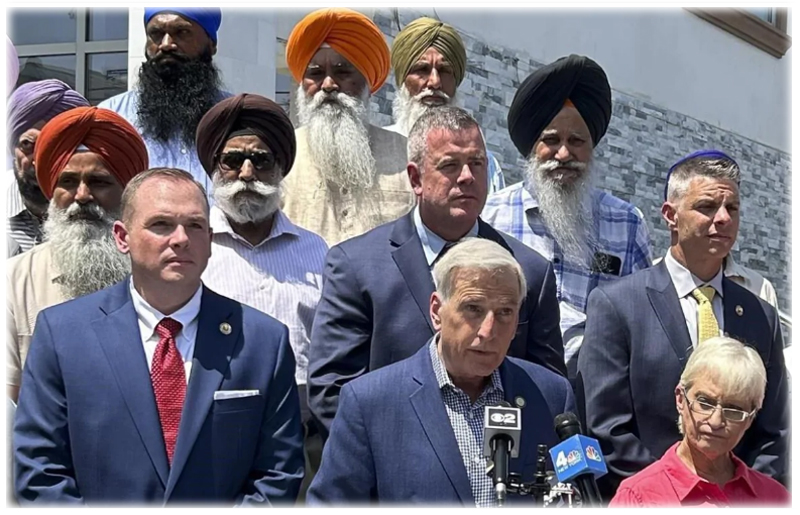
Cultural Clash: New York Sikh officer’s quest for Turban and beard in police uniform
In a disheartening incident, a Sikh New York state trooper was denied his right to grow facial hair for his wedding, despite a state law in 2019 that mandated employers to accommodate attire or grooming obligations based on religious beliefs.
Trooper Charanjot Tiwana, stationed in Jamestown, New York, had sought permission to grow his beard to one-half inch in length, a practice deeply rooted in his religious commitment as a Sikh.
Unshorn hair and beards hold significant cultural and religious value for practicing Sikh men, which unfortunately clashed with the grooming rules enforced by the State Police, requiring troopers to shave and keep their hair short. The denial of Tiwana’s request was justified on the grounds of safety concerns related to the use of a gas mask, as stated by the New York State Troopers Police Benevolent Association, his union.
It is essential to acknowledge that wearing a turban is also a customary practice for Sikh men. However, Tiwana refrained from formally requesting permission to wear one while on duty, primarily due to the rejection of his beard request. This unfortunate situation has led to feelings of persecution among the Sikh community.
Charlie Murphy, the president of the New York State Troopers Police Benevolent Association, emphasized the importance of ensuring that all New Yorkers, including law enforcement officers, have the freedom to practice their religion without facing oppression from their employers.
The New York State Police, while confirming that Tiwana had submitted a religious accommodation request, declined to comment on the outcome or the reasons behind the denial. The department’s spokesperson, Deanna Cohen, emphasized their commitment to diversity, equity, and inclusion, stating that they engage in the reasonable accommodation process for all such requests from NYSP employees.
This incident sheds light on the larger issue of diversity within the New York State Police force. The department has faced challenges in diversifying its workforce, with only a small percentage of Black and Hispanic troopers compared to the respective proportions in the state population.
Fortunately, in recent years, some police departments in the United States have taken steps to address such issues and become more inclusive. For instance, Detroit’s police force started allowing officers to wear beards in 2016, and Philadelphia permitted short beards for officers facing shaving-related issues, primarily common among Black men. Newark’s police department began allowing Muslim officers to wear the hijab while on duty, and in New York City, Sikh officers have been permitted to wear turbans since 2016.
Notably, in 2022, a federal court ruled in favor of Sikh U.S. Marine recruits, allowing them to keep their beards during boot camps.
While the New York State Police are working on a policy regarding turbans, it is crucial to emphasize the need for sensitivity towards cultural and religious practices like wearing turbans and growing beards among Sikh troopers.
In 2019, New York state passed a law requiring all employers, including state agencies, to accommodate workers with religious requirements for attire or facial hair, as long as these requirements do not interfere with essential job duties. This law prompted employers to review and update their grooming and dress code policies accordingly.
State Assemblyman David Weprin, the sponsor of the 2019 state law, expressed shock upon hearing about Tiwana’s denial of religious accommodations. He highlighted that such accommodations have been made in almost every agency and emphasized the importance of upholding religious rights.
It is high time for greater awareness and sensitivity towards the cultural and religious significances of practices like wearing turbans and growing beards among Sikh individuals. Sikhs should not have to compromise their faith to serve their country or their communities. It is our collective responsibility to foster an environment that respects and accommodates diverse religious beliefs while ensuring the safety and security of all individuals. Only then can we truly embrace a society that celebrates its diversity and inclusivity. With collective efforts, we can envision a future where Sikhs, adorned in turbans and beards, proudly serve as New York State troopers, representing the true spirit of unity and acceptance.
(Image and text credit: Khalsavox.com)
Support Our Journalism
We cannot do without you.. your contribution supports unbiased journalism
IBNS is not driven by any ism- not wokeism, not racism, not skewed secularism, not hyper right-wing or left liberal ideals, nor by any hardline religious beliefs or hyper nationalism. We want to serve you good old objective news, as they are. We do not judge or preach. We let people decide for themselves. We only try to present factual and well-sourced news.
Support objective journalism for a small contribution.


