Colombia: Security Council hears of ‘epidemic of violence’ against civil society and ex-combatants
While political actors in Colombia are uniting to confront COVID-19, they must also work together to fight “the epidemic of violence” against civil society leaders, human rights defenders and former combatants, the head of the UN mission in the country said on Tuesday during a Security Council meeting held by videoconference.
Carlos Ruiz Massieu reported that despite a national quarantine to avert the spread of the new coronavirus disease, this violence “continues unabated”, with six deaths reported in recent weeks.
“Just as Colombian actors are uniting to confront the pandemic, it is imperative for all actors to end the epidemic of violence against social leaders, human rights defenders and former combatants”, he said.
The on-going bloodshed is “one of the deepest wounds in our national conscience”, said David Santiago Cano Salazar, Colombian Ambassador for One Young World, who also addressed the Council.
He recently participated in a National Conversation, launched by President Iván Duque Márquez, during which youth leaders from rural areas revealed that they are afraid to speak up for their communities due to intimidation by illegal armed groups.
Priorities amid the pandemic
Ending this violence is fundamental for the functioning of mechanisms established under the 2016 UN-backed peace deal that ended five decades of fighting between Government forces and the rebel group known as FARC, Ruiz Massieu told the Council.
These mechanisms include the National Commission on Security Guarantees, which is designing public policy on dismantling illegal armed groups, and the National Protection Unit, which is reviewing more than 400 requests for close protection schemes.
It is also key to improving security for nearly 9,500 ex-combatants living outside former camps for demobilized fighters, known as Territorial Areas for Training and Reintegration (TATRs). Overall, 195 former fighters have been killed since the final peace agreement was signed in November 2016.
Strengthening processes that support the longer-term reintegration of former combatants is another priority.
“The consequences of the pandemic make it even more crucial to pay particular attention to former combatants living outside TATRs, as they have more precarious access to basic services like clean water and sanitation”, he said.
Additionally, communities, especially victims, must remain at the centre of peacebuilding efforts.
COVID-19 and peace deal implementation
The UN mission chief underlined the importance of moving forward with the full implementation of the Peace Agreement, which requires constant engagement by the parties.
Negotiations initially began in 2012 and the agreement was announced in August 2016. However, following a referendum which failed to ratify the deal, a final revised agreement was signed that November.
Ruiz Massieu said the quarantine and other restrictions brought about by the pandemic will undoubtedly pose challenges, but the parties and others involved in the crucial implementation are adapting to the situation. Colombians also are responding positively to calls for unity at this time.
“COVID-19 is and will continue affecting the implementation of the Peace Agreement and the Mission’s verification activities. However, we have a collective obligation to ensure progress in its implementation. Peace in Colombia cannot be, and should not be, a casualty of this pandemic”, he said.
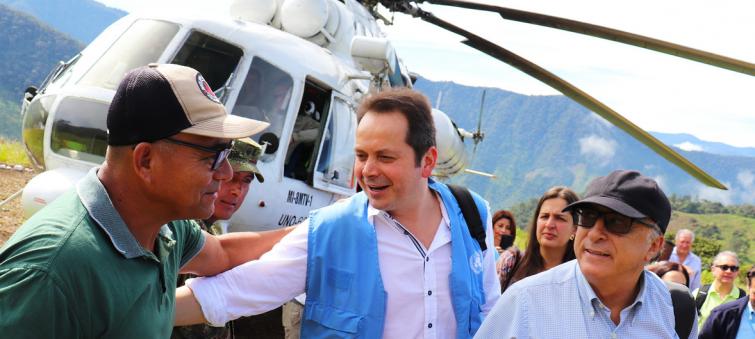
Photo caption and credit: UN Verification Mission in Colombia The Head of the United Nations Verification Mission in Colombia, Carlos Ruiz Massieu (centre), greets an ex-combatant on a field mission to Antioquia in the South American country.
Support Our Journalism
We cannot do without you.. your contribution supports unbiased journalism
IBNS is not driven by any ism- not wokeism, not racism, not skewed secularism, not hyper right-wing or left liberal ideals, nor by any hardline religious beliefs or hyper nationalism. We want to serve you good old objective news, as they are. We do not judge or preach. We let people decide for themselves. We only try to present factual and well-sourced news.
Support objective journalism for a small contribution.