


Central African Republic: UN urges support to meet basic needs in hard-hit province
The most urgent needs are food, health support and education, the Senior Humanitarian Coordinator in the CAR, Claire Bourgeois, said in a press release on Monday, after visiting the Vakaga province this past weekend with representatives of the Ministry of Humanitarian Affairs, agencies and partners to assess the needs of people there.
“I met people who had to flee to this remote area from their homes in Bangui and are terrified to go back,” Bourgeois said.
“It is imperative to secure access for convoys delivering aid supplies from Bangui and to increase protection programmes. Otherwise, we risk further deterioration of the humanitarian situation in the region,” she warned.
Vakaga province has suffered from years of instability, violence and chronic insecurity, while its geographical remoteness and poor infrastructure have cut it off from the rest of the country. The current closure of the Chadian border is having a major negative impact on food and other supplies for communities in the area, the humanitarian coordinator said.
Noting that she was impressed by the “spirit and resilience of the community,” Bourgeois said that during her visit, authorities and communities repeatedly drew her attention to the need to start the school year in the entire province.
“It is unacceptable to hear that classes at the primary school will not start in the new school built and routine immunization cannot be conducted because the much-needed fridge is not in place due to road insecurity and the regular chain supply of vaccines is on standstill,” Bourgeois stressed.
She also noted that it is imperative to secure access for convoys delivering aid supplies from Bangui and to increase protection programmes, such as those dealing with gender-based violence and the safeguarding of children from recruitment by armed groups.
“Alternatively, we risk further deterioration of the humanitarian situation in the region,” she said.
In all, nearly 1 million people have been displaced and 2.5 million are in need of immediate assistance in CAR, Bourgeois said. One fifth of Central Africans have fled their homes for refuge in sites for internally displaced people, with host families, and in neighbouring countries.
Thousands of people are estimated to have been killed in CAR as a result of a conflict that erupted when mainly Muslim Séléka rebels launched attacks in December 2012. The violence has since taken on increasingly sectarian overtones.
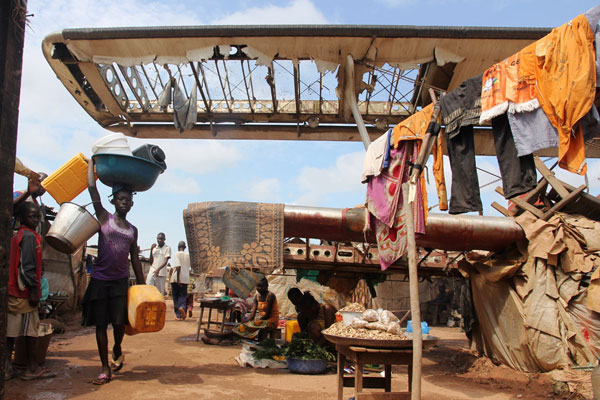
A fresh wave of violence which swept Bangui, Central African Republic in mid-October, forced more than 7,000 people to flee for safety in and around the capital. Photo: OCHA/Gemma Cortes
Support Our Journalism
We cannot do without you.. your contribution supports unbiased journalism
IBNS is not driven by any ism- not wokeism, not racism, not skewed secularism, not hyper right-wing or left liberal ideals, nor by any hardline religious beliefs or hyper nationalism. We want to serve you good old objective news, as they are. We do not judge or preach. We let people decide for themselves. We only try to present factual and well-sourced news.
Support objective journalism for a small contribution.


