


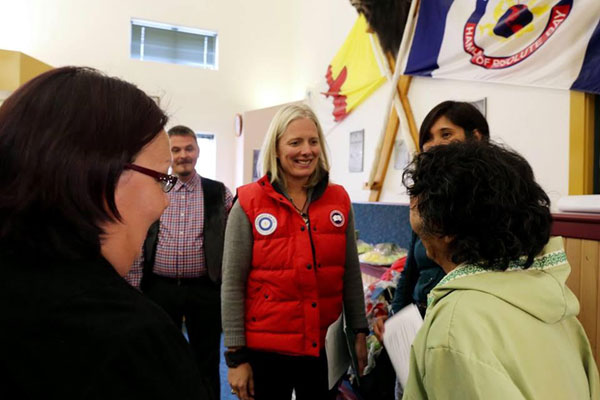
Catherine McKenna studies Inuit culture, climate change during her visit to Inuit-led National Park
Inuit people lived in Northern coast Labrador -- a large area of mainland Canada, separated from Newfoundland, an island in the Atlantic Ocean by the Strait of Belle Isle -- and quickly adapted to the arctic and sub-arctic conditions of the Labrador region, CBCNews reports said.
Newfoundland and Labrador together form the most easterly province in Canada.
The coastal areas of Labrador had reportedly abundance of whales, seals, fish, caribou and large forests.
McKenna said she watched the Inuit hunt seals and was also able to see firsthand the effects of climate change in the north.
During her visit to the Torngat Mountains -- ancestral home of the Labrador Inuit and managed by Inuit staff -- she was accompanied by Natan Obed, president of the national Inuit organization, Inuit Tapiriit Kanatami.
Inuit Tapiriit Kanatami is a nonprofit organization in Canada that represents over 60,000 Inuit and works to improve their health and wellbeing through research, advocacy, public outreach and education.
"He was able to tell me about the Inuit experience in the park, so I could learn a lot more about our history — which is a lot longer than 150 years, that's for sure — and really understand the Inuit connection with the land," McKenna was quoted by the media as saying.
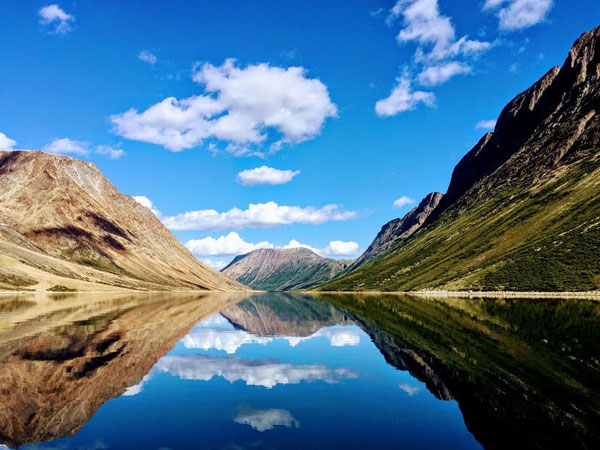 In the middle of the trek to the top of the Torngat Mountains, McKenna said that the bear guard spotted a black bear and she was thankful to the guard for protecting her from the bear.
McKenna also tweeted that she had an opportunity to meet with scientists & Inuit elders at Torngat Mountains to learn about Parks Canada Science.
During an exclusive interview about her tour with scientist Darroch Whitaker near Labrador's Torngat Mountains Base Camp and Research station -- a remote site Labrador and gateway to Torngat Mountains National Park and Hebron National Historic Site -- she said her purpose of coming there was two fold, first to study the life of people living there as part of reconciliation, and second, to study about climate change.
McKenna said that she is working to find ways how to link Environment and Climate Change Canada scientists with the park ecologists and biologists and Indigenous Peoples to advance their knowledge about the effects of climate change.
She said Canada’s Arctic, abode of Inuit people, was one of the most vulnerable regions in the world to the impacts of climate change.
"We see it [across the country] in floods. We now have forest fires, we have droughts. But in the arctic, that's the canary in the coal mine."
"They are already seeing double the warming. That's having a real impact in very tangible ways," CBCNews reports quoted her as saying.
Inuit people of the parks were focused at the micro level, said McKenna, on what’s happening in parks, whereas Environment and Climate Change Canada scientists were studying the impact of climate change at a national and macro level.
She added it was possible to achieve much more by engaging the local community in monitoring and said she hoped to apply the lessons from her tour in the park to her work with the environment in Ottawa, Canada.
Amazed by the stunning beauty of Torngat Mountains, the National park, its biodiversity, the animals, people living here, with a long history, she said she would have to think of the best ways to narrate the story of the Park when she returned to Ottawa.
(Reporting by Asha Bajaj)
Images: Catherine McKenna/Twitter; Torngat Mountains/Twitter
Support Our Journalism
We cannot do without you.. your contribution supports unbiased journalism
IBNS is not driven by any ism- not wokeism, not racism, not skewed secularism, not hyper right-wing or left liberal ideals, nor by any hardline religious beliefs or hyper nationalism. We want to serve you good old objective news, as they are. We do not judge or preach. We let people decide for themselves. We only try to present factual and well-sourced news.
Support objective journalism for a small contribution.


