


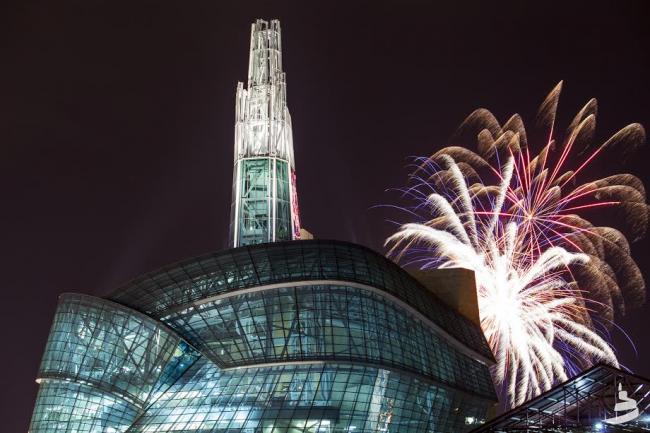
Canadian Museum for Human Rights wins international award for inclusion
The award is presented annually for outstanding contributions towards building an inclusive world where everyone can live together comfortably and without barriers to participation in daily life, regardless of ability, age, gender, ethnicity or other factors.
The CMHR was recognized for its efforts to create a rich museum experience for people of all abilities - in wayfinding and physical accessibility, exhibition design, visitor services, public programming, and interactions with both digital and non-digital content.
"We committed to a 'design-for-all' approach at the earliest stages in our development, and our standards continue to evolve as we work with the disability community and our visitors, learning what works and what doesn't," said CMHR President and CEO John Young. "Being internationally recognized helps build awareness and sensitivity across our entire industry, which can help improve accessibility standards everywhere."
Corey Timpson, the CMHR's Vice-President of Exhibitions, Research and Design, will present the Museum's inclusive approach to 5,000 delegates from over 30 countries who are attending this week's conference in Japan. The IAUD is an organization based in Japan that promotes the creation, through products and services, of a society where more people feel comfortable to live.
CMHR will also focus on inclusion and accessibility for people of all abilities during events held at the Museum in Winnipeg for International Human Rights Day.
Admission is free all day on Dec 10 and includes demonstrations of assistive technology used by people who are blind or non-verbal, a guide dog presentation, and performances by a Deaf mime troupe and an all-abilities dance group. Sign-language interpreters and touch-signal intervenors (who assist people who are Deaf-blind) will be positioned throughout the building.
This month marks the 10th anniversary of the United Nations Convention on the Rights of Persons with Disabilities.
A museum for everyone: inclusive approach to design
The Canadian Museum for Human Rights decided to adopt an inclusive design methodology from the start, rather than designing something first and adapting it later to be accessible. Inclusion became a mandate across the organization and a key characteristic of the corporate culture.
An Inclusive Design Advisory Council (IDAC) was established. It now consists of a dozen members with a various disabilities from across Canada. This council helps the Museum make informed decisions and connects it to disability communities for further prototyping, testing and criticism. A National Test Group was established, made up of 30 people from across the country who use various adaptive technologies.
Design standards were developed for everything from typography and built structures to optimal reach distances and digital presentations. These standards surpass Smithsonian guidelines and set new Canadian and world standards for universal accessibility.
All digital media in the Museum (over 100 hours of video and film) includes descriptive audio, sign-language interpretation, open captions and individual volume control.
The Museum developed a unique Universal Keypad (UKP) with help from the Inclusive Design Research Centre at the Ontario College of Art and Design University. The UKP allows blind and low-vision people to navigate digital touchscreens via tactile buttons and text-to-speech functions. These visitors can have content read aloud, control volume, zoom screens and access all digital media. The keypad also includes a wrist-rest for those with upper-body mobility challenges.
Over 150 iBeacons have been installed throughout the Museum to deliver content to visitors' mobile devices through a unique app, enabling text-to-speech readers to describe text panels and visual attributes for visitors who are blind or low-vision. Universal Access Points with raised numbers, Braille, and tactile floor markers indicate the location of iBeacon points where new information can be found using the app's "Near Me" mode.
The app includes supplemental content in sign language and augmented reality, and a self-guided tour for visitors of all abilities.
CMHR standards for inclusive design are a living, evolving product. This leads to creation of increasingly more inclusive experiences for visitors. It also builds awareness and sensitivity about the needs of visitors of all abilities -- not only among CMHR teams but across the cultural industry.
www.notitntown.net
Support Our Journalism
We cannot do without you.. your contribution supports unbiased journalism
IBNS is not driven by any ism- not wokeism, not racism, not skewed secularism, not hyper right-wing or left liberal ideals, nor by any hardline religious beliefs or hyper nationalism. We want to serve you good old objective news, as they are. We do not judge or preach. We let people decide for themselves. We only try to present factual and well-sourced news.
Support objective journalism for a small contribution.


