


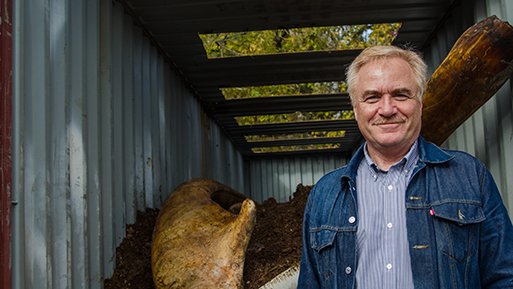
Canada's Royal Ontario Museum holding interactive exhibition on the rare Blue Whale
Thexhibtion describes in detail the tragic death of nine rare blue whales trapped in ice in 2014 off the coast of Newfoundland (which, along with Labrador, forms one of the territories of Canada), media reports said.
This exhibition is a collaborative project led by ROM’s Dr. Mark Engstrom, Senior Curator and Deputy Director of Collections and Research.
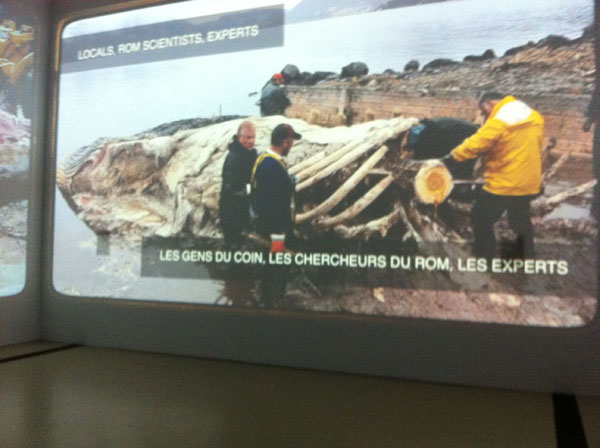 Other participants include Burton Lim, Assistant Curator of Mammalogy; Jacqueline Miller, Mammalogy Technician; Oliver Haddrath, Ornithology Technician; Dave Ireland, Managing Director of ROM Biodiversity, and Gerry De Iuliis, Lecturer in the Department of Ecology & Evolutionary Biology at the University of Toronto.
In May 2014, a small ROM team had travelled to Newfoundland to salvage a Blue Whale that had washed ashore.
This unfortunate event presented ROM with a unique opportunity to study Blue Whales, one of marine mammals, listed as endangered species under Schedule 1 of the Federal Species at Risk Act.
Schedule 1 of the Federal Species at Risk Act is a key commitment by federal government to prevent wildlife species from becoming extinct and provides measures for the legal protection of wildlife species and the conservation of their biological diversity.
It is said that not more than 20,000 blue whales are present in the world, with the North-western Atlantic Population being the lowest, with 200 to 400 whales.
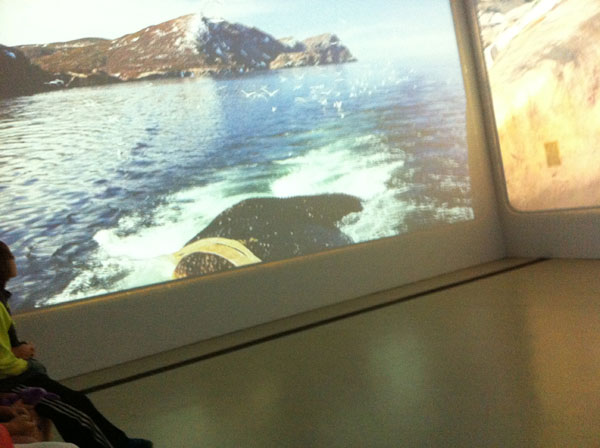 Dr Jack Lawson, a researcher with the Federal Department of Fisheries and Oceans (DFO) in St John’s, Newfoundland had flown over that particular area where the tragedy had occurred and confirmed that nine blue whales were dead in the icebergs while several others were found alive and swimming.
Blue whales usually sink when they die, but this time two of the dead blue whales washed ashore in Trout River and Rocky Harbour, Newfoundland and Labrador.
Although the beached whales caused a global alarm, the DFO and ROM discussed ways to recover these whales for scientific research and educational purposes.
“Salvaging the blue whale in Newfoundland was a once in a lifetime experience,” Lin was quoted by media.
Not being able to determine the cause of death of these nine whales, researchers at ROM began to contemplate what these whales usually feed upon and found out that they fed exclusively on tiny crustaceans called krills.
When the temperature rises in late winter and early spring, huge swarms of krill are found in the Gulf of St. Lawrence -- outlet of the North American Great Lakes via the Saint Lawrence River into the Atlantic Ocean -- and blue whales track these krills.
The experts studied the association between krills and blue whales to find out if it could provide any clue to the cause of death.
The winter of 2014 was reportedly very cold with heavy build-up of ice in the Gulf.
There is a possibility, reflected the researchers, that the Blue Whales in the area were feeding when ice shifted just north of where two currents passed through the Cabot Strait, which is between Cape Ray, Newfoundland and Cape North, Cape Breton Island.
It was presumed by ROM researchers that the nine blue whales, spotted in March, were trapped under the ice and consequently died.
The reported damage to the skulls of the two whales that were found on the beach and were salvaged on the west coast of Newfoundland, suggesting that ice had crushed them.
But the researchers could not determine at that time if skulls of these whales were crushed by ice before or after their death.
Their loss reportedly represented about three percent of the Northwest Atlantic’s blue whale population; in Canada, that’s almost equivalent to the human population of Saskatchewan.
"This was an opportunity for us, born of tragedy, to make something more of life," Mark Engstrom, Senior Curator and Deputy Director of Collections & Research was quoted by the media.
Opened in 1914 ROM, Canada's largest museum, houses a collection of more than six million objects and specimens, presented in 40 gallery and exhibition spaces to showcase art, culture, and nature from around the world and across all ages.
(Reporting by Asha Bajaj)
Support Our Journalism
We cannot do without you.. your contribution supports unbiased journalism
IBNS is not driven by any ism- not wokeism, not racism, not skewed secularism, not hyper right-wing or left liberal ideals, nor by any hardline religious beliefs or hyper nationalism. We want to serve you good old objective news, as they are. We do not judge or preach. We let people decide for themselves. We only try to present factual and well-sourced news.
Support objective journalism for a small contribution.


