Cameroon host to families fleeing Nigeria, Lake Chad basin: UN relief official
"Many fled overnight, leaving all they had behind,” Toby Lanzer, UN Regional Humanitarian Coordinator for the Sahel, said after a week-long visit to Yaoundé, Cameroon, and the Far North region to assess the mounting humanitarian impact of the crisis in neighbouring northeast Nigeria and the Lake Chad Basin.
“They now rely on humanitarian assistance and the scarce resources of host communities that were already on the brink before the crisis,” Lanzer said.
Grave concerns persist for some 20 million people in the Sahel region of Africa, according to the UN Office for the Coordination of Humanitarian Affairs (OCHA).
Recurrent conflict, erratic weather patterns, epidemics and other shocks continue to weaken the resilience of households across a region still suffering chronic levels of food insecurity and malnutrition.
And beyond the chronic threats of food insecurity, malnutrition and epidemics, violent conflict in and around the Sahel region has led to a surge in population displacement.
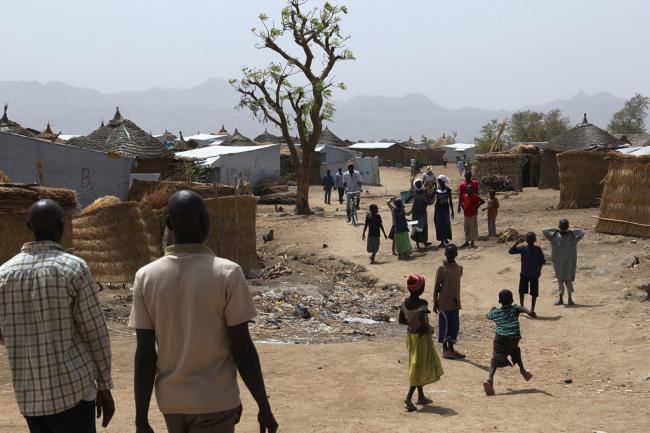
Cameroon’s Far North region hosts almost 200,000 forced migrants, including 80,000 internally displaced persons and over 57,000 Nigerian refugees who fled the violence and settled either in the Minawao refugee camp or with local communities along borders areas.
“Families on the run often survived brutal attacks and face severe trauma,” said Lanzer.
He said, “As if this was not enough of a burden, we now worry that their lives are threatened by the lack of food and water, malnutrition and deadly epidemics such as cholera and measles.
In the Far North, food insecurity has dramatically spiked in recent months, affecting one in every three people.
Insecurity is undermining population movements, daily commercial and agricultural activities, adversely impacting the livelihoods of communities still recovering from a decade of droughts.
“As farmers were forced to flee away from their lands, many will miss the harvest next month. Without timely humanitarian assistance, communities may take years to recover,” he urged.
Funding of Cameroon’s humanitarian appeal covers barely 40 per cent of the needs, threatening the viability of humanitarian response to the Far North over the coming months.
“Food distributions, access to health services and psycho-social care are among our top priorities to save lives and restore the dignity of the displaced,” according to Najat Rochdi, the UN Humanitarian and Resident Coordinator in Cameroon.
He said, “A renewed engagement by development actors is also essential if we are to address the root causes of chronic vulnerability and ensure stability of the region in a durable manner.”
Photo: OCHA/Ivo Brandau
Support Our Journalism
We cannot do without you.. your contribution supports unbiased journalism
IBNS is not driven by any ism- not wokeism, not racism, not skewed secularism, not hyper right-wing or left liberal ideals, nor by any hardline religious beliefs or hyper nationalism. We want to serve you good old objective news, as they are. We do not judge or preach. We let people decide for themselves. We only try to present factual and well-sourced news.
Support objective journalism for a small contribution.