 Climate Change
By 2030, half world’s population will be exposed to flooding, storms, tsunamis
New York: By the year 2030, an estimated 50 per cent of the world's population will live in coastal areas which are exposed to flooding, storms and tsunamis.
That is why the United Nations has chosen enhancing international cooperation for developing countries, as the theme of this year’s World Tsunami Awareness Day.
In a message marking the day, the UN Secretary-General called on all countries, international bodies, and civil society, to increase understanding of the deadly threat, and share innovative approaches to reduce risks.
“We can build on progress achieved – ranging from better outreach to tsunami-exposed communities around the world, to the inclusion of a Tsunami Programme in the UN Decade of Ocean Science for Sustainable Development”, António Guterres said.
The UN chief cautioned, however, that the risks “remain immense.”
“Rising sea levels caused by the climate emergency will further exacerbate the destructive power of tsunamis”, he said. “We must limit warming to 1.5 degrees over pre-industrial averages and invest at scale in the resilience of coastal communities.”
Rapid urbanization and growing tourism in regions prone to tsunamis, are also putting even more people in harm’s way.
Common effort
For Mr. Guterres, science, international cooperation, preparedness and early action must be at the centre of all efforts to keep people and communities safer.
“Boosting support to developing countries and improving detection and early warning is critical. In the face of increasing complex global crises, we need to be better prepared”, he argued.
In 2021, World Tsunami Awareness Day is promoting the "Sendai Seven Campaign,” specifically the target that looks to enhance international cooperation to developing countries.
The Secretary-General concludes his message with an appeal to deliver on the Sendai Framework, and, together, build resilience against all disasters.
Rare but deadly
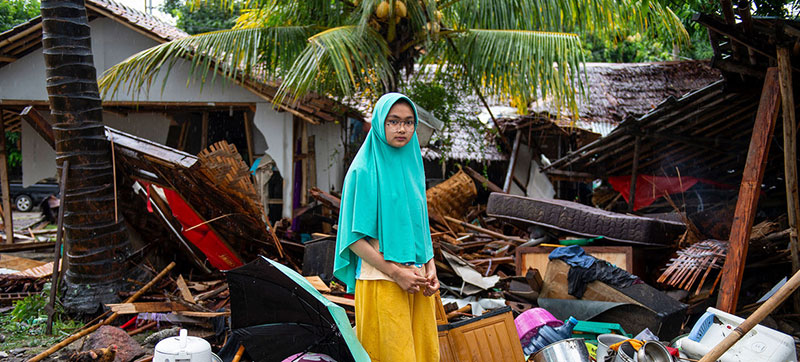
Tsunamis are rare events but can be extremely deadly.
In the past 100 years, 58 of them have claimed more than 260,000 lives, or an average of 4,600 per disaster - more than any other natural hazard.
The highest number of deaths occurred in the Indian Ocean tsunami of December 2004, that caused an estimated 227,000 fatalities across 14 countries. Indonesia, Sri Lanka, India and Thailand were the hardest hit.
Just three weeks after the disaster, the international community came together in Kobe, Japan, and adopted the 10-year Hyogo Framework for Action, the first comprehensive global agreement on disaster risk reduction.
They also created the Indian Ocean Tsunami Warning and Mitigation System, which uses seismographic and sea-level monitoring stations to send alerts to national tsunami information centres.
After the Hyogo Framework for Action expired, in 2014, the world adopted the Sendai Framework for Disaster Risk Reduction 2015-2030, outlining seven clear targets and four priorities to prevent and reduce disaster risks.
Support Our Journalism
We cannot do without you.. your contribution supports unbiased journalism
IBNS is not driven by any ism- not wokeism, not racism, not skewed secularism, not hyper right-wing or left liberal ideals, nor by any hardline religious beliefs or hyper nationalism. We want to serve you good old objective news, as they are. We do not judge or preach. We let people decide for themselves. We only try to present factual and well-sourced news.
Support objective journalism for a small contribution.