At UN event, officials call for ensuring 'fundamental human right' to quality education
“Something very important is at stake – the future,” Deputy Secretary-General Jan Eliasson declared in his opening remarks at the Global Education First Initiative (GEFI) high-level event held on the margins of the General Assembly in New York.
“Many countries have made major strides,” Eliasson continued. “We must not let them down.”
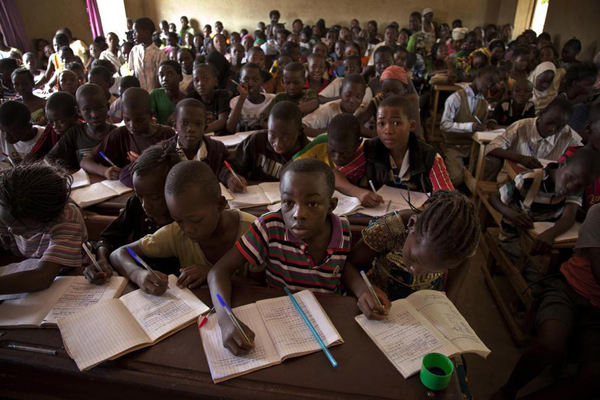
He pointed out, however, that with 58 million children still out of school worldwide and 250 million primary school-aged children in the world still unable to read, delegates were faced with some “uncomfortable facts.”
“The world is now experiencing a global learning crisis,” the Deputy Secretary-General stated, adding that there were “308 million reasons” to focus on improving access to quality education which is “a fundamental human right.”
“Quality education is more than an entry point into the job market. It is the foundation for personal fulfilment, for gender equality, for social cohesion, for sustainable development, for economic growth, and for responsible global citizenship.”
Launched in September 2012 by Secretary-General Ban Ki-moon, the Initiative seeks to put every child in school, improve the quality of learning, and foster global citizenship.
In delivering the keynote address to the event, the First Lady of the United States, Michelle Obama, echoed Eliasson, declaring that the international community had made “tremendous progress” on the issue of global education. She warned, however, that the world “should not be satisfied” with its successes and added that much remained to be achieved in terms of gender equality in education.
“When it comes to educating adolescent girls,” said Obama, “the real challenge isn’t about resources; it’s about attitudes and beliefs.”
Obama cited her own experiences, as a daughter and a mother, to illustrate the important role men can play in promoting the education of women. But, she added, encouraging gender quality was also key and she emphasized that “addressing gender-based violence must also be on the agenda.”
The Director-General of the UN Educational, Scientific and Cultural Organization (UNESCO) and co-organizer of the Initiative, Irina Bokova, similarly affirmed that the need for quality education was an “imperative,” especially for girls and women.
Bokova noted that among the 58 million children out of school worldwide, girls and young women were still “hit hardest” and warned that the lack of education not only “threatens stability” but also “condemns entire generations to despair.”
This message was echoed by the UN Special Envoy for Global Education, Gordon Brown, who underscored the link between female education and the schoolgirls of Chibok, Nigeria, kidnapped by Boko Haram militants last April. The Nigerian schoolgirls, Brown said, were kidnapped for the sole reason that they sought an education and he urged the international community to resurrect its global efforts in supporting those girls still held in captivity.
In addition, Brown emphasized the importance of schooling in unlocking the future potential of children and noted the obstacles that still lay in the way of universal education for many children around the world.
“We cannot deliver universal education unless we end child marriage. We cannot deliver universal education unless we end child labour,” Brown said.
“Education first is not a slogan, but a priority,” he concluded. “Education first, education foremost, education forever.”
Children at a public school in Bamako, Mali. UN Photo/Marco Dormino
Support Our Journalism
We cannot do without you.. your contribution supports unbiased journalism
IBNS is not driven by any ism- not wokeism, not racism, not skewed secularism, not hyper right-wing or left liberal ideals, nor by any hardline religious beliefs or hyper nationalism. We want to serve you good old objective news, as they are. We do not judge or preach. We let people decide for themselves. We only try to present factual and well-sourced news.
Support objective journalism for a small contribution.