


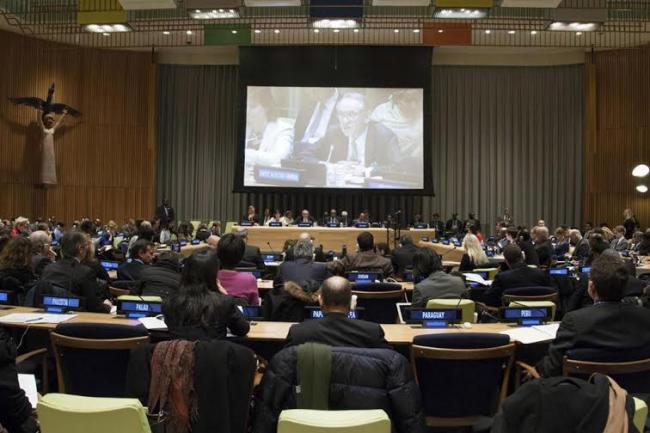
At thematic debate, UN calls on Member States to boost funding for post-2015 development
“There are high expectations that the United Nations and its Member States will be a catalyst for setting the direction for transformative change,” Eliasson said this morning at a High-Level Thematic Debate on Means of Implementation for a Transformative Post-2015 Development Agenda.
“You, the Member States, are on the final stretch of an historic journey to define the content of an ambitious post-2015 development agenda.”
Addressing the debate which opened on Monday and will wrap up tomorrow at UN Headquarters in New York, Eliasson reminded delegates that 2015 would witness the marking of “three major milestones” – the Third International Conference on Financing for Development, to be held in Addis Ababa, Ethiopia, in July; the post-2015 summit scheduled for New York, in September; and a critical UN climate conference set for December in Paris.
As momentum builds towards these events, he continued, Member States will be pressed to answer how they plan “to deliver on these ambitious goals.”
“It is clear that on Monday’s financing and investment patterns will not deliver sustainable development – even though current global savings are actually sufficient to finance sustainable development needs,” Eliasson explained. “Intensified international cooperation on many fronts and in new ways is needed to change the way finance for development works.”
This year marks wrap up of the landmark UN Millennium Development Goals (MDGs), which world leaders agreed on 15 years ago. There has been significant progress in meeting the targets. For example, global poverty has been halved well ahead of the 2015 deadline; in developing countries, 90 per cent of children now enjoy primary education; the number of people lacking access to improved drinking water has halved, and the fight against malaria and tuberculosis has shown results, according to the UN.
But challenges persist, and with the deadline of the MDGs set for the end of this year, the UN will craft a new set of targets known as the sustainable development goals (SDGs). Globally, 73 million young people are looking for work and many more are trapped in exploitative jobs. In recent years, more than two and a half million more children in affluent countries fell into poverty, bringing the total above 76 million.
Echoing the Deputy-Secretary-General’s appeal for better financing to satisfy the “ambition, breadth and scope” of the new UN development agenda, President of the General Assembly, Sam Kutesa, warned that the additional funding needed to eradicate extreme poverty ranged from $135 billion to $195 billion every two years, while investments required in critical infrastructure projects spanning transport, energy, water and sanitation are estimated to cost between $5 and $7 trillion per year. As a result, he said, it is clear that the resources required remained “enormous” and would have to be “mobilized from all sources” – domestic and external to public and private.
“The new universal development agenda represents our collective commitment to humankind and the planet,” affirmed Kutesa.
“Together, we must spare no effort to formulate and agree on a framework for development and international cooperation that improves the everyday lives of people worldwide, and protects the environment.”
UN Photo/Loey Felipe
Support Our Journalism
We cannot do without you.. your contribution supports unbiased journalism
IBNS is not driven by any ism- not wokeism, not racism, not skewed secularism, not hyper right-wing or left liberal ideals, nor by any hardline religious beliefs or hyper nationalism. We want to serve you good old objective news, as they are. We do not judge or preach. We let people decide for themselves. We only try to present factual and well-sourced news.
Support objective journalism for a small contribution.


