


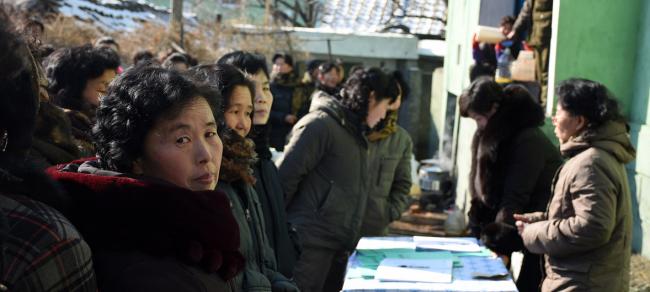
‘Critical test’ for North Korea’s Government as civilian suffering remains rife, warns UN rights expert
New York, Jan 12 (IBNS): The human rights situation in Democratic People’s Republic of Korea – DPRK - remains “extremely serious”, and along with international demands for denuclearization, this constitutes a “a critical test” for the year ahead, a senior UN-appointed expert said on Friday.
Tomás Quintana was speaking in his capacity as UN Special Rapporteur on human rights in DPRK, commonly known as North Korea; his press conference was held in the South Korean capital, Seoul, as he continued to be denied access to its northern neighbour.
Quintana urged the DPRK authorities to engage with his mandate and allow him to visit the country “to hear the voice of the people and the authorities”.“Of those who left the North recently that I interviewed during this mission, every person gave accounts of ordinary people being subjected to exploitative labour and serious human rights violations such as forced evictions in the name of development,” he said. “Stories were told to me of people, including children, being subjected to long hours of labour where they were forced to work without remuneration…. One person concluded: “the whole country is a prison.”
Many ordinary people ‘being left behind’
He detailed personal testimonies gathered during his five-day mission about “political prison camps” which contain “thousands of people” accused of committing crimes against the State.
Their detention happens without “due process guarantees or fair trial, in a manner that amounts to enforced disappearances with the family not knowing their whereabouts”, the Special Rapporteur explained, before highlighting that people’s “fear” of being imprisoned was “very real and deeply embedded in the consciousness of the ordinary North Korean people”.
Surveillance and close monitoring of ordinary citizens is also a fact of life in DPRK, Quintana continued, as well as other restrictions on basic freedoms, not least the prohibition on leaving the country.
His comments follow a historic meeting between DPRK leader Kim Jong-Un and US President Donald Trump in Singapore last June, which focused on denuclearization talks.
Humanitarian aid remains ‘vital’
Noting that Kim had stated that “improving people’s standard of living radically” was a priority in his New Year message, Quintana said that this might represent “recognition” of economic and social hardships for ordinary people.
It “represents an important first step towards taking action to address the challenges,” the UN expert said, before calling on the international community to continue to support the “vital” humanitarian assistance that was being provided by various actors to the people of the DPRK.
“In particular, it is important that humanitarian cooperation is extended without politicization and in full respect of the principles of neutrality and independence,” he said, reiterating a call to the UN Security Council to ensure its sanctions do not have a detrimental impact on the people of the DPRK.
The findings of Quintana’s latest report will be delivered to the Human Rights Council in Geneva at its next regular session which begins in late February.
WFP/Colin Kampschoer
Support Our Journalism
We cannot do without you.. your contribution supports unbiased journalism
IBNS is not driven by any ism- not wokeism, not racism, not skewed secularism, not hyper right-wing or left liberal ideals, nor by any hardline religious beliefs or hyper nationalism. We want to serve you good old objective news, as they are. We do not judge or preach. We let people decide for themselves. We only try to present factual and well-sourced news.
Support objective journalism for a small contribution.


