


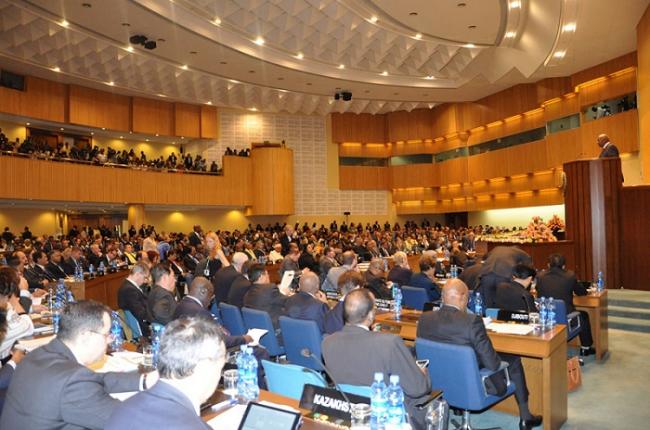
Addis: UN talks resume on financing framework for global development
Deliberations are being held in the 'Main Committee' established by the Third International Conference on Financing for Development with a view to finalizing the outcome document, which will be known as the Addis Ababa Action Agenda once it is adopted.
Chaired by Ethiopia's Foreign Minister, Tedros Adhanom, the committee has before it the task of bridging differences on three main areas of contention in the 35-page draft outcome document.
The final text, once adopted, will support the implementation of the post-2015 development agenda, including the set of Sustainable Development Goals (SDGs) that world leaders are expected to adopt this September.
In an interview with the UN News Centre, Alexander Trepelkov, Director of the Financing for Development Office in the Department of Economic and Social Affairs (DESA), highlighted the unresolved issues, which include the principle of common but differentiated responsibilities.
He said, “In view of the fact that the Addis Action Agenda goes beyond the Monterrey Consensus [the outcome of the first development financing conference, held in Mexico in 2002] to address all the three dimensions of sustainable development, developing countries propose to make explicit reference to the principle of common but differentiated responsibilities as it applies to financing sustainable development as a whole.”
Currently, the reference to this principle is contained in the paragraph dealing with climate finance.
The second area of contention relates to the area of international cooperation on tax matters. “In general, developing countries, as a precondition to agreeing to the universal financing agenda, are asking for a more inclusive mode of discussion and a seat at the table in policy decision-making on financing for development,” Trepelkov explained.
In that context, developing countries are proposing upgrading the UN Committee of Experts on International Cooperation in Tax Matters to an intergovernmental body, or at least to strengthen the Committee vis-à-vis the role of the Organisation for Economic Cooperation and Development (OECD) on tax cooperation.
“The exact relationship between the UN work on tax matters and the OECD work in the same area remains to be clarified,” Trepelkov stated.
Thirdly, the precise relationship of the Addis outcome document and the post-2015 development agenda still needs to be agreed.
“Developed countries see the Addis outcome as the means of implementation of the post-2015 development agenda, while developing countries believe that Addis should of course support the implementation of the SDGs but should not preclude additional efforts in this area,” said Trepelkov.
The conference that began on Monday includes plenary sessions, round tables and side events held all around Addis Ababa.
It is being held at the highest political level, with 28 heads of State, vice presidents and heads of government; six deputy prime ministers; and 95 ministers and vice-ministers attending.
In addition, some 1,000 representatives from civil society and the business sector are expected to be in Addis for the conference, which concludes on Thursday.
Photo: ECA
Support Our Journalism
We cannot do without you.. your contribution supports unbiased journalism
IBNS is not driven by any ism- not wokeism, not racism, not skewed secularism, not hyper right-wing or left liberal ideals, nor by any hardline religious beliefs or hyper nationalism. We want to serve you good old objective news, as they are. We do not judge or preach. We let people decide for themselves. We only try to present factual and well-sourced news.
Support objective journalism for a small contribution.


