 Kerala
‘Women should remain confined at home’: Kerala cleric’s remarks trigger fresh controversy
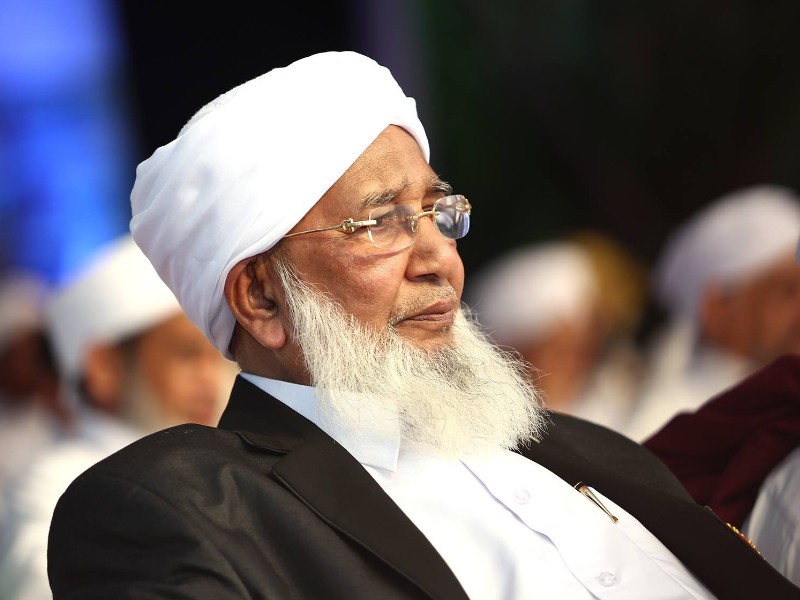
Kerala grand mufti Sheikh Abubakr Ahmad has triggered a fresh controversy after saying women should remain within their homes and should not enter the public sphere.
Speaking at the Hubbul Rasool conference in Kochi, the cleric, also known as Kanthapuram AP Aboobacker Musliyar, defended the purdah system and said it was intended to protect women's dignity.
He compared women with gold ornaments that, he said, need to be kept safely inside a box, arguing that bringing women into public life could result in "great destruction".
"Women should remain confined within their homes. They should not enter the public sphere. The Holy Quran says so," Kanthapuram said.
He maintained that such restrictions were not intended to diminish women but rather to honour and protect them.
Cleric's gold necklace analogy
During his speech, Kanthapuram illustrated his argument through an analogy involving a gold necklace.
He described how a customer buying a gold necklace from a jewellery shop would see it taken out carefully from a cupboard, a box and its wrapping before it was displayed.
He contrasted this with a stone grinder sold at a neighbouring shop, which, he said, could be left by the roadside where people could walk past or even step over it.
Kanthapuram argued that leaving a valuable gold necklace exposed in a similar manner would allow anyone passing by to touch it and eventually diminish its beauty and value.
"If the necklace has to retain its beauty, it has to be kept safely inside a box," he said.
"If women are brought out into the public sphere like this, it will lead to great destruction. It is because of this that Islam prescribed the purdah system for women," he added.
The cleric repeated his assertion that the Quran required women to remain within their homes and said the principle should be understood even when viewed "intelligently".
'Religious scholars upheld position for decades'
Kanthapuram said religious scholars, particularly those associated with the Samastha Kerala Jamiyyathul Ulama, had advocated the position for around a century.
According to him, the approach had helped women in the country "maintain their dignity".
The cleric is the general secretary of the All-India Sunni Jamiyyathul Ulama as well as the Samastha Kerala Jem-iyyathul Ulama.
He is widely known among Sunni Muslims as the grand mufti of India.
His latest remarks have brought renewed attention to his views on women's role in society and the interpretation of religious practices.
'Islam elevated women’s status'
Earlier in the same address, Kanthapuram argued that Islam had historically improved the status of women.
He referred to female infanticide in pre-Islamic Arabia and said Islam prohibited the killing of girl children.
He also pointed to women's property and inheritance rights, arguing that Islam had granted women legal and social recognition at a time when they lacked such rights.
"Islam gave women a great position," Kanthapuram said.
He maintained that restrictions on women entering the public sphere should also be understood as a means of showing respect towards them.
‘We will continue to say it’
Kanthapuram also responded to organisations and individuals who questioned his authority to make such statements about Islam.
He said religious scholars had studied Islamic teachings and therefore had both the authority and responsibility to explain their understanding of the faith.
"We have studied the religion. Therefore, it is our duty to say this. We will say it, and we will continue to say it. Nobody can stop it," he said.
The cleric further argued that his organisation did not interfere in the religious practices of other communities and said Muslim scholars should similarly be free to address members of their own community.
"We have the right to speak to the Muslim community. We will continue to do so. Nobody here can stop it," Kanthapuram added.
Support Our Journalism
We cannot do without you.. your contribution supports unbiased journalism
IBNS is not driven by any ism- not wokeism, not racism, not skewed secularism, not hyper right-wing or left liberal ideals, nor by any hardline religious beliefs or hyper nationalism. We want to serve you good old objective news, as they are. We do not judge or preach. We let people decide for themselves. We only try to present factual and well-sourced news.
Support objective journalism for a small contribution.