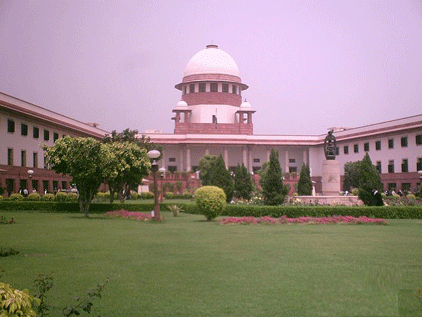
Supreme Court refuses to intervene now in Judicial Appointment Bill
The apex court called it premature to intervene in the matter now and asked the petitioners to approach in the appropriate time.
Earlier, the court had agreed to hear petitions challenging National Judicial Appointments Commission Bill, 2014 after petitions against it were filed.
The top court took up three petitions that oppose the scrapping of the collegium system of five senior most judges deciding on appointments and transfers in the higher judiciary.
The petitioners have alleged that the Bill is unconstitutional.
The upper house of Parliament- Rajya Sabha- on Aug 14 passed the National Judicial Appointments Commission Bill, 2014 and Constitutional Amendment Bill, a new proposal that scraps the collegium system in the appointment of the judges and thus gives the Executive in the selection of judges though a Commission.
Now the judges would not be appointed only by a collegium of senior Supreme Court judges but by a panel of Commission of six members comprising the Chief Justice of India, the next two most senior judges of the Supreme Court, the Law Minister, and two eminent personalities, the last two to be selected by the Prime Minister and the Leader of Opposition.
The Bill now awaits the President's approval.
Support Our Journalism
We cannot do without you.. your contribution supports unbiased journalism
IBNS is not driven by any ism- not wokeism, not racism, not skewed secularism, not hyper right-wing or left liberal ideals, nor by any hardline religious beliefs or hyper nationalism. We want to serve you good old objective news, as they are. We do not judge or preach. We let people decide for themselves. We only try to present factual and well-sourced news.
Support objective journalism for a small contribution.