 Aravalli
Supreme Court puts Aravalli redefinition on hold amid uproar, awaits new expert committee
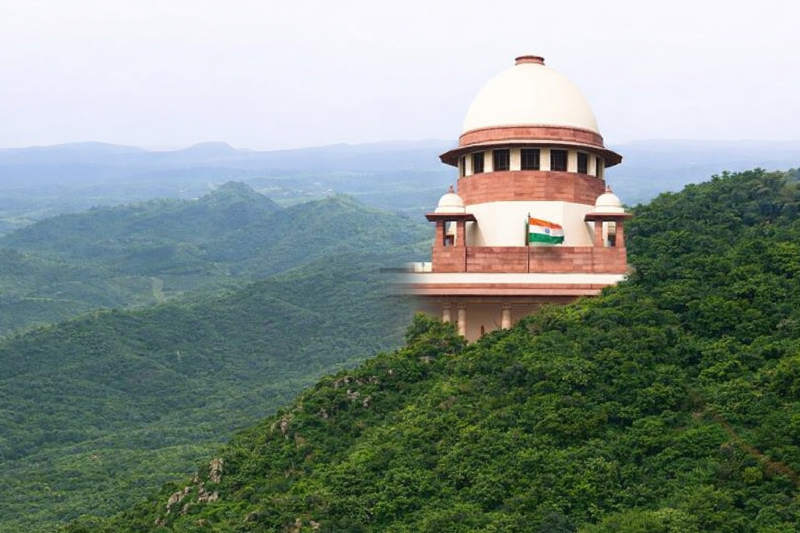
New Delhi/IBNS: The Supreme Court on Monday put on hold its earlier order concerning the revised definition of the Aravalli Hills, stating that its observations and the expert committee’s report had been misconstrued, media reports said.
Hearing a suo motu case initiated amid growing concerns over the Aravalli range, a bench comprising Chief Justice of India Surya Kant, Justice J K Maheshwari and Justice A G Masih said further clarification was required before the court’s directions and the committee’s recommendations could be implemented.
“We deem it necessary that the committee recommendations and directions of this court be kept in abeyance. The stay will remain in effect till the constitution of the committee,” the bench said, as quoted by Live Law.
During a hearing on November 20, the Supreme Court had accepted the recommendations of a Union environment ministry panel on the definition of landforms to be considered part of the Aravalli Hills. In an affidavit filed before the court, the Centre proposed that only landforms with an elevation of 100 metres or more above local relief, along with their slopes and adjoining areas, be classified as Aravallis.
The court, led by then CJI B R Gavai, accepted the revised definition and directed the environment ministry to formulate a Management Plan for Sustainable Mining for the Aravalli region. The move triggered strong opposition from political parties and environmental activists, who raised concerns about the potential impact on ecological protection.
Amid the controversy, the Union Ministry of Environment, Forest and Climate Change last week directed all concerned states to impose a complete ban on the grant of new mining leases across the entire Aravalli range, stretching from Delhi to Gujarat.
The ministry said the prohibition would apply uniformly and was aimed at preserving the integrity of the ancient geological formation by curbing illegal and unregulated mining. It added that the directions were intended to safeguard the Aravallis as a continuous ridge, amid long-standing concerns over environmental degradation.
The ministry has also tasked the Indian Council of Forestry Research and Education (ICFRE) with identifying additional areas across the Aravallis where mining should be prohibited, beyond zones already restricted. The exercise will be based on ecological, geological and landscape-level considerations.
ICFRE has been asked to prepare a comprehensive, science-based Management Plan for Sustainable Mining for the entire Aravalli region. The plan will assess cumulative environmental impacts, ecological carrying capacity, identify conservation-critical and ecologically sensitive zones, and outline restoration and rehabilitation measures. The draft plan will be placed in the public domain for stakeholder consultation.
The latest directions came days after Union Environment Minister Bhupender Yadav dismissed claims that recent changes related to the Aravallis were aimed at opening the region to mining, terming such assertions “misinformation”.
Yadav said the government was pursuing a balanced approach that takes ecology and economy together, while remaining firmly committed to protecting the Aravalli ecosystem. He clarified that no mining is permitted in the Delhi-NCR region and that legally sanctioned mining accounts for only a small portion of the Aravalli landscape.
The ministry reiterated that the fresh measures would expand the coverage of areas protected from mining, recognising the Aravallis’ crucial role in preventing desertification, conserving biodiversity, recharging aquifers and providing essential environmental services.
Support Our Journalism
We cannot do without you.. your contribution supports unbiased journalism
IBNS is not driven by any ism- not wokeism, not racism, not skewed secularism, not hyper right-wing or left liberal ideals, nor by any hardline religious beliefs or hyper nationalism. We want to serve you good old objective news, as they are. We do not judge or preach. We let people decide for themselves. We only try to present factual and well-sourced news.
Support objective journalism for a small contribution.