 ADMM-Plus
Rajnath Singh says Indo-Pacific must stay free from coercion
Defence Minister Rajnath Singh on Saturday reaffirmed India’s commitment to an open, inclusive, and rules-based Indo-Pacific, free from any form of coercion, as global unease grows over China’s increasing military assertiveness in the region.
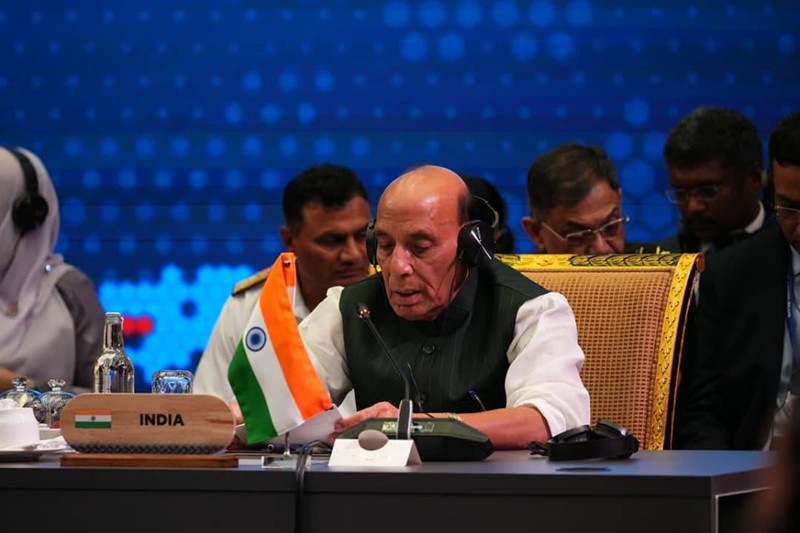
Speaking at the ASEAN Defence Ministers’ Meeting Plus (ADMM-Plus) in Kuala Lumpur, Malaysia, Singh underlined that India stands for strengthening the ASEAN-led regional security architecture, which he described as central to ensuring lasting peace and stability across the Indo-Pacific.
‘Cornerstone of India’s Act East Policy’
Calling the ADMM-Plus a “cornerstone” of India’s Act East Policy and its wider Indo-Pacific strategy, Singh said the forum has transformed regional defence dialogue into a practical framework for cooperation.
He stressed that India’s growing partnership with ASEAN reflects both political maturity and a convergence of regional priorities.
“For India, the ADMM-Plus is a vital part of its Act East Policy and its broader Indo-Pacific vision. While India’s engagement with ASEAN predates this platform, the mechanism has provided a structured space for defence collaboration, further strengthening our diplomatic and economic ties,” Singh said.
He added that the elevation of the ASEAN-India partnership to a Comprehensive Strategic Partnership in 2022 symbolised not only the depth of political trust but also a shared commitment to maintaining regional stability and an open, rules-based order.
From ‘Look East’ to ‘Act East’
Tracing the trajectory of India’s engagement with Southeast Asia, Singh noted that the Look East Policy, launched in 1992 to promote economic integration, evolved into the Act East Policy in 2014 under Prime Minister Narendra Modi — marking a shift toward decisive and action-oriented regional engagement.
Speaking on the theme “Reflection on 15 Years of ADMM-Plus and Charting the Way Forward,” Singh highlighted India’s proactive participation in the forum’s Experts’ Working Groups, hosting of joint field exercises, and contribution to establishing common operational standards.
He said India’s involvement aligns closely with ASEAN’s own strategic outlook, making the relationship “complementary, not competitive.”
“India views its defence cooperation with ASEAN and other countries as a contribution to regional peace, stability, and capacity development,” the minister said, reaffirming New Delhi’s vision of inclusive security.
A decade and a half of cooperation
Reflecting on ADMM-Plus’s evolution since its inception in 2010, Singh said the platform has grown beyond being merely a dialogue mechanism.
“Over the past fifteen years, ADMM-Plus has evolved into a dynamic and result-oriented framework for practical defence cooperation,” he observed.
He also welcomed Malaysia’s 2025 ASEAN Chairmanship theme, “Inclusivity and Sustainability,” noting its importance in building a more equitable and resilient regional order.
“Inclusivity in security ensures that all nations—regardless of their size or capacity—become equal partners in shaping regional stability. Sustainability, meanwhile, calls for resilient security structures that can adapt to emerging challenges and foster long-term cooperation rather than temporary alignments,” Singh said.
The ADMM-Plus framework
The ADMM (ASEAN Defence Ministers’ Meeting) serves as ASEAN’s top defence consultative body, while ADMM-Plus brings together ASEAN’s ten member states — Brunei, Cambodia, Indonesia, Laos, Malaysia, Myanmar, the Philippines, Singapore, Thailand, Timor-Leste, and Vietnam — along with eight dialogue partners: India, the United States, China, Russia, Japan, South Korea, Australia, and New Zealand.
Established to strengthen security and defence ties, the ADMM-Plus provides a platform for member and partner nations to engage in cooperative initiatives such as counter-terrorism, humanitarian assistance, peacekeeping, maritime security, and disaster relief.
India has been an ASEAN dialogue partner since 1992 and participated in the inaugural ADMM-Plus meeting in Hanoi, Vietnam, in 2010.
Since 2017, the forum has been held annually to deepen cooperation among ASEAN and its partner countries.
Under the current framework, India co-chairs the Experts’ Working Group on Counter-Terrorism with Malaysia for the 2024–2027 cycle, underscoring its continued engagement in advancing regional security initiatives.
Singh’s remarks in Kuala Lumpur reiterated New Delhi’s long-held position that the Indo-Pacific must remain open, inclusive, and governed by international law, even as regional tensions rise amid China’s expanding maritime and military presence.
His message echoed India’s broader strategic intent — to uphold freedom of navigation, respect for sovereignty, and a cooperative security order in a region increasingly defined by competing ambitions.
Support Our Journalism
We cannot do without you.. your contribution supports unbiased journalism
IBNS is not driven by any ism- not wokeism, not racism, not skewed secularism, not hyper right-wing or left liberal ideals, nor by any hardline religious beliefs or hyper nationalism. We want to serve you good old objective news, as they are. We do not judge or preach. We let people decide for themselves. We only try to present factual and well-sourced news.
Support objective journalism for a small contribution.