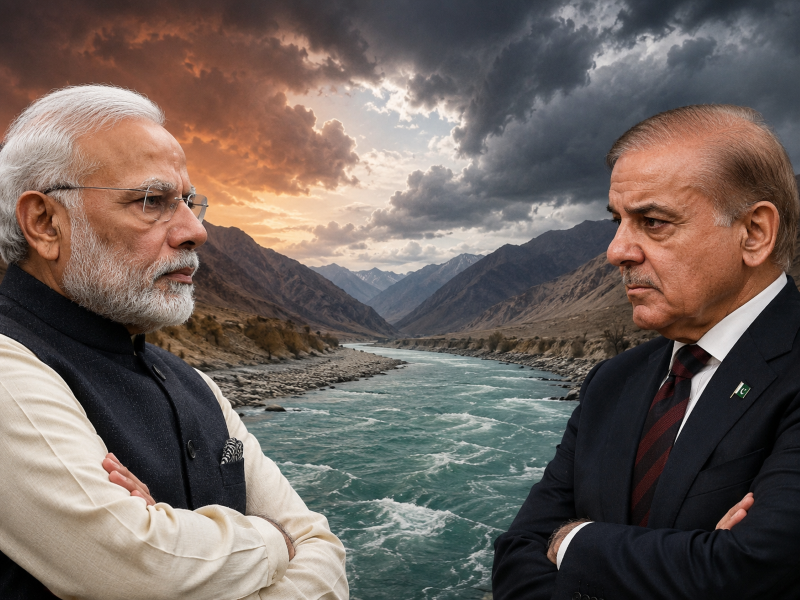
 Bilateral
Indus Waters Treaty row: India rejects Hague court order, says ‘no jurisdiction’ over its sovereign decisions
New Delhi/IBNS: India has maintained its decision to keep the Indus Waters Treaty (IWT) in abeyance, rejecting a ruling by the Hague-based Court of Arbitration that said the treaty remains in force and must be respected.
New Delhi said the tribunal has no jurisdiction over India's sovereign decisions, maintaining that the arbitration body was constituted by the World Bank in breach of the treaty and that India has neither appeared before it nor accepted its proceedings.
The latest development has brought the decades-old India-Pakistan water-sharing agreement back into focus, with the two countries taking sharply divergent positions over its status.
India rejects tribunal's jurisdiction
The Ministry of External Affairs (MEA) has maintained that India's decision of April 2025 to place the Indus Waters Treaty in abeyance continues to remain in force.
India has also rejected the tribunal's authority to rule on its sovereign decisions, saying its present or future pronouncements will have no effect on India's actions concerning its hydroelectric projects.
The position directly conflicts with the Court of Arbitration's latest ruling that the treaty remains in force and that India continues to be bound by its obligations, including restrictions governing hydroelectric projects on the western rivers.
What is the Indus Waters Treaty?
The Indus Waters Treaty was signed by India and Pakistan on September 19, 1960, after nearly a decade of negotiations mediated by the World Bank. The agreement was aimed at resolving disputes over the sharing of the Indus river system following the Partition of India in 1947.
Under the treaty, the eastern rivers — Ravi, Beas and Sutlej — were allocated to India, while the western rivers — Indus, Jhelum and Chenab — were allocated largely for Pakistan's use.
India was, however, permitted certain uses of the western rivers, including domestic and agricultural purposes as well as run-of-the-river hydropower projects, subject to restrictions laid down under the treaty.
The agreement also established the Permanent Indus Commission, comprising representatives from both countries, and laid down mechanisms for addressing differences and disputes.
Despite wars, diplomatic crises and prolonged tensions between India and Pakistan, the treaty remained operational for more than six decades.
Why did India suspend the treaty?
The situation changed following the April 22, 2025 Pahalgam terror attack, in which 22 civilians were killed.
On April 23, 2025, India announced that it was placing the Indus Waters Treaty in abeyance, linking the decision to Pakistan's alleged support for cross-border terrorism.
The move formed part of India's broader response to the attack and further escalated tensions between the two nuclear-armed neighbours.
What is the current dispute?
The latest dispute centres on an arbitration process concerning India's hydroelectric projects on the western rivers.
The Permanent Court of Arbitration in The Hague has maintained that the Indus Waters Treaty remains in force and that India continues to have obligations under the agreement.
India, however, has rejected the ruling, arguing that the tribunal was illegally constituted and lacks jurisdiction over the matter.
The disagreement has therefore created a sharp legal and diplomatic divide: while the arbitration court maintains that India's treaty obligations continue, New Delhi insists that its decision to keep the treaty in abeyance remains valid and that the tribunal's pronouncements cannot constrain India's sovereign actions.
Support Our Journalism
We cannot do without you.. your contribution supports unbiased journalism
IBNS is not driven by any ism- not wokeism, not racism, not skewed secularism, not hyper right-wing or left liberal ideals, nor by any hardline religious beliefs or hyper nationalism. We want to serve you good old objective news, as they are. We do not judge or preach. We let people decide for themselves. We only try to present factual and well-sourced news.
Support objective journalism for a small contribution.