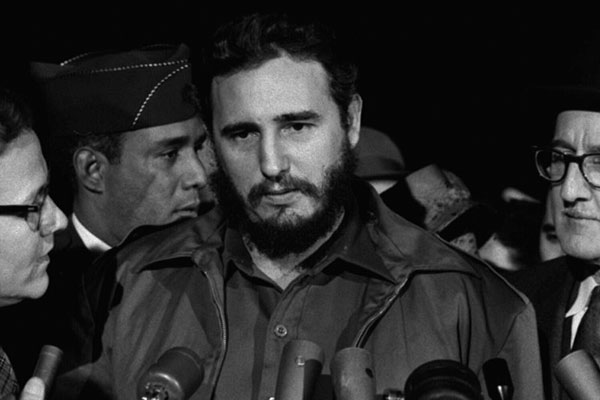
Fidel Castro (August 13, 1926 – November 25, 2016): Last of the communist icons
Born on August 13, 1926 into a wealthy farmer's family in Cuba's Oriente province, Castro embraced leftist anti-imperialist politics while studying law at the University of Havana.
In later years, he formed a revolutionary group in Mexico, the 26th of July Movement, with his brother Raul and Che Guevara. Returning to Cuba, then ruled by Fulgencio Batista, Castro played a crucial role in the Cuban revolution, powered by guerrilla warfare.
After Batista's overthrow in 1959, Castro assumed military and political power as Cuba's Prime Minister.
The United States was alarmed by Castro's friendly relations with the Soviet Union, and unsuccessfully attempted to remove him by assassination, economic blockade, and counter-revolution, including the Bay of Pigs invasion of 1961, which was backed by the Central Intelligence Agency (CIA).
Castro formed an alliance with the Soviets and allowed them to place nuclear weapons on the island, which resulted in the Cuban Missile Crisis, that raised the prospect of a nuclear war in 1962.
Castro's long rule for nearly five decades defied the hostile foreign policy of of ten US Presidents, while he survived a staggering number assassination attempts and steered the island nation through a tumultuous period.
In him the US and rightists found a difficult enemy who succeeded in keeping the island away even from the disastrous consequences of the fall of Communism in the Soviet Union and the Left forces their last icon and the hope for the crusade they always dreamt to wage against capitalism.
Though he was often criticised by many as an despot supressing dissent and causing sufferings to many Cubans who fled homeland, Castro's Cuba made a remarkable advancement in education and health care that can be a showpiece for developing countries.
Cuba’s reorganization and expansion of the educational system in the early 1960s also made education universally accessible and increased investment in people (human capital.) As a result, Cuba moved from 5th place in Latin America in terms of literacy and school enrolment in 1970 to 1st in 2007.
Cuba succeeded in reorganizing its medical system so as to provide universal access to health services, and managed to obtain excellent results relative to the amounts of resources that it was able to devote to the health sector.
As a result, Cuba’s health indicators improved quickly and remain among the very best in Latin America
He sent people to the most rural areas to teach the farmers how to read, set up free hospital attention and schools, including colleges free of charge for everyone.
he also did a lot of international aid to other countries, such as sending doctors and nurses to care for ill people in really rural areas in el salvador, argentina, guatemala and other Latin American countries.
With the loss of Soviet subsidization and the near 40 per cent decline in income per capita from 1989 to 1994, Cuba reorganized its economy, “depenalizing” the use of the US dollar, legalizing farmers’ markets, liberalizing self-employment and promoting new economic activities and exports.
The stupendous achievement that Cuba can boast for under Castro's leadership is its resilience. With no support from the international financial institutions of which it was not a member, thanks to the embargo with the United States, Cuba survived, at a cost borne almost directly, immediately and totally by its citizens.
And that describes his image among the Leftists world over.
"Homeland or death! Socialism or death! We shall overcome"- Castro once said in a famous speech, making clear his role as a nationalist Cuban and a Socialist beckoning others to do the impossible.
Support Our Journalism
We cannot do without you.. your contribution supports unbiased journalism
IBNS is not driven by any ism- not wokeism, not racism, not skewed secularism, not hyper right-wing or left liberal ideals, nor by any hardline religious beliefs or hyper nationalism. We want to serve you good old objective news, as they are. We do not judge or preach. We let people decide for themselves. We only try to present factual and well-sourced news.
Support objective journalism for a small contribution.