Demonetisation effect: Long queues in front of banks to change old notes
With banks and automated teller machines (ATMs) remaining closed on Wednesday, people lined up before banks across India since Thursday morning to change the notes.
Union Finance Minister Arun Jaitley had tweeted on Wednesday. "Legal tender cancellation of currency has some transient problems but we planned to handle it efficiently.No citizen will face inconvenience."
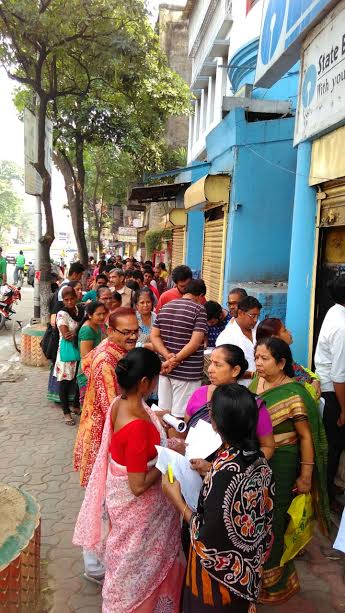 But the ground reality for the common man was rather different.
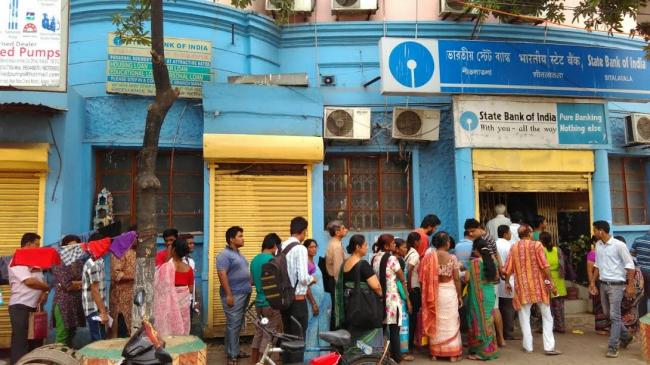
Long queues in front of banks have been reported from most cities and towns since early morning.
In many areas, the queues snaked across pavements for a long way.
Many of those queuing up were salaried people who said they did not have enough small change at home to do daily shopping.
Daily wage earners and labourers, who have their savings in the now demonetised notes, were also seen anxiously queuing up.
 Not only Indians, even foreigners who had changed their currency into Indian notes, were reportedly seen worrying about getting their demonetised notes changed and were crowding to the forex bureaus.
Prime Minister Narendra Modi on Tuesday said that hospitals, railway, bus and airlines ticket counters will continue to accept Rs. 500 and Rs. 1,000 old notes till the next 72 hours, which ends on Friday midnight.
With private hospitals not exempt from the special treatment, patients in these hospitals are facing problems while being discharged.
Airlines companies have announced that they will accept the demonetised notes exclusively for ticket sales; for any other service, such as paying for excess baggage, passengers cannot use the banned notes.
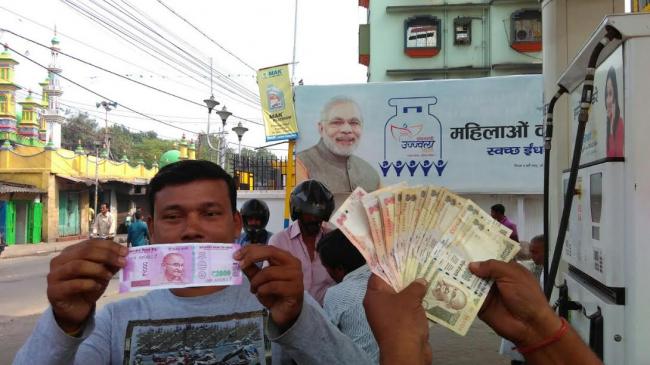
Petrol pumps and medicine shops are complaining that people are spending small amounts and insisting on paying with five hundred rupee notes to get quick change.
Even though banks have decided to operate beyond their normal closing hours, some began to face shortage of cash towards the end of day, according to reports.
A bank branch on Lenin Sarani found it had run out of cash around four pm to the consternation of those still standing in queue.
The Golden Temple in Amritsar, Punjab, announced on Thursday that it will not accept demonetised currency notes from devotees.
In West Bengal, where Jagaddhatri Puja was being celebrated while the demonetisation declaration was made on Tuesday, the puja organisers had a tough time paying the vendors or buying offerings, flowers, etc, which are usually transacted using higher currencies.
Travellers, especially who have been travelling in remote areas, have also complained that the sudden news has jeopardised their travel plans as hotels and restaurants are refusing payment in demonetised notes.
Tweeted Union Finance Minister on Wednesday, "500/1000 legal tender cancellation will end an illegitimate parallel economy & gradually advance India into a cashless economy."
Many e-companies have either stopped cash-on-delivery presently or are accepting COD orders only for specified sums, according to reports.
Some food delivery services in Kolkata are reportedly sending their delivery boys armed with the portable card swipe machines.
The mobile wallet companies, such as PayTM, Freecharge and Mobikwik, expect a jump in their user base, according to reports.
According to The Financial Express, PayTM "saw a whopping 435 per cent increase in overall traffic, 200 per cent hike in number of app downloads and 250 per cent surge in number of overall transactions and transaction value — all within hours of the decision being made public."
"MobiKwik said it has witnessed over 40 per cent increase in download of its within less than 18 hours of the announcement, while user traffic and merchant queries went up by 200 per cent among its over 35 million users," also reported The Financial Express.
The Reserve Bank of India (RBI), in a release on Thursday, said that consequent to the banks being open for public transactions on Saturday, November 12 and Sunday, November 13, 2016, it has been decided that Payment Systems (RTGS, NEFT, Cheque Clearing, Repo, CBLO and Call markets) shall remain open on Saturday, November 12 and Sunday, November 13, 2016.
The RBI has advised all participants/member banks to facilitate operations on the above payment systems for their customers on November 12 and 13, 2016 as on regular working days.
Images: A scene of a bank in Kolkata.
Support Our Journalism
We cannot do without you.. your contribution supports unbiased journalism
IBNS is not driven by any ism- not wokeism, not racism, not skewed secularism, not hyper right-wing or left liberal ideals, nor by any hardline religious beliefs or hyper nationalism. We want to serve you good old objective news, as they are. We do not judge or preach. We let people decide for themselves. We only try to present factual and well-sourced news.
Support objective journalism for a small contribution.