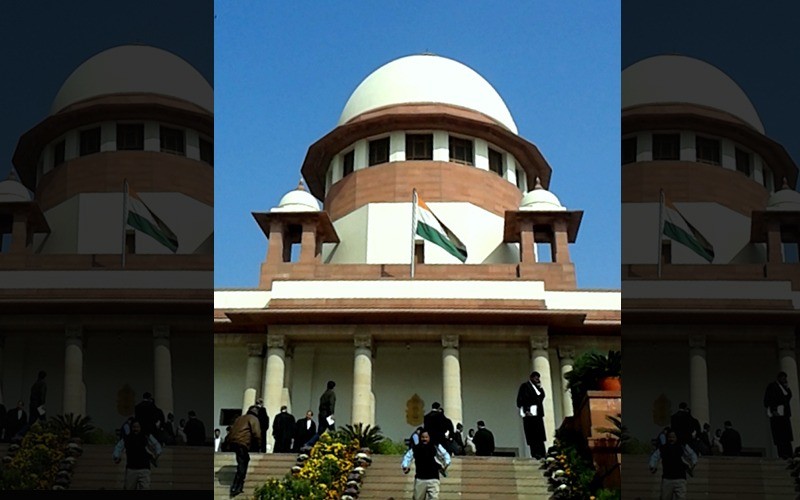
Centre defends Waqf laws in Supreme Court, says it would oppose any interim stay
New Delhi/IBNS: The Centre on Friday said it would oppose any stay, partial or complete, on the implementation of the new Waqf laws as the Supreme Court hears petitions challenging the same.
In a submission this afternoon, the Narendra Modi government argued that in such cases, it is a settled position in law and that courts do not have the authority to stay statutory provisions, either directly or indirectly.
"There is a presumption of constitutionality that applies to laws made by Parliament and an interim stay is against the principle of balance of powers," it said, "The law has been made on the recommendations of a Joint Parliamentary Committee... followed by an extensive debate in both Houses of Parliament."
"And, while the Supreme Court undoubtedly has the power to examine the constitutionality of the law, at this interim stage the grant of an injunction against operation of any provision would be violative... of the delicate balance of power between the different branches of the State."
The Centre also said the petitions in this case "do not complain of injustice in any individual case" and, therefore, do not call for protection by any interim order.
Last week, the apex court said that it would not trespass into the domain of the Legislature, and that the separation of powers had been made clear by the Constitution.
The Supreme Court is hearing a batch of petitions (whittled down from nearly 200) challenging the new laws, which include rules that non-Muslim members must be part of the Central Waqf Council and state-specific boards, and that donations may only be made by practicing Muslims.
The petitioners have argued that these violate multiple fundamental rights.
The apex court had raised concerns over the violence sparked during the protests.
It had also questioned the Centre if Muslims would be included in the Hindu religious boards.
At the end, the judges raised three points, indicating their intention to pass an interim order, which would put some provisions of the amended law on hold.
The top court said it intended to maintain the status quo for all three procedures, on which the rules have been amended.
According to the judges, whatever property has been declared as Waqf by the user or declared by the court will not be notified.
Support Our Journalism
We cannot do without you.. your contribution supports unbiased journalism
IBNS is not driven by any ism- not wokeism, not racism, not skewed secularism, not hyper right-wing or left liberal ideals, nor by any hardline religious beliefs or hyper nationalism. We want to serve you good old objective news, as they are. We do not judge or preach. We let people decide for themselves. We only try to present factual and well-sourced news.
Support objective journalism for a small contribution.