October 04, 2026 10:16 am (IST)

Follow us:


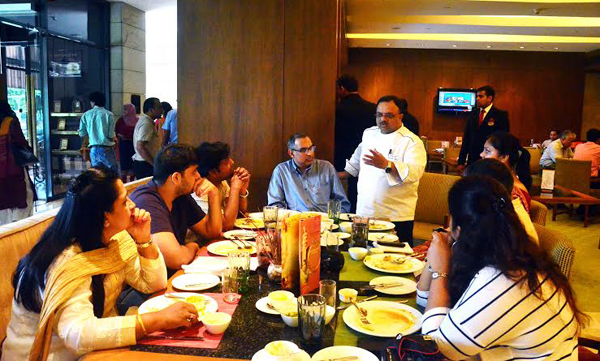
In the company of the Sheherwalis
Kolkata, Aug 27 (IBNS): The Sheherwali food festival organised by ITC Sonar in Kolkata, from August 25-31, 2015, is not only an opportunity to sample an almost forgotten culinary spread but also an eye-opener into one of Bengal’s forgotten historical chapters.
It was not about eating a meal. Or sampling a culinary spread. It was instead a walk down memory lane.
“That is exactly what we are aiming to do,” explained executive chef Mayank Kulshrestha, as we settled down for lunch at the Eden Pavilion in ITC Sonar, Kolkata.
In its endeavour to make Indian cuisine a part of the global culinary space, ITC Hotels, through its Kitchens of India platform, has decided to showcase “India’s wealth of unique, undiscovered, royal and forgotten cuisines through food festivals at its different units,” explained Kulsheshthra. The Sheherwali food festival is the first of the series..jpg)
Before the food arrived, we dug into the history of the Sheherwalis. About 400 years ago, when Bengal was still under the Nawabs and Murshidabad was the capital, the Europeans discovered the fine textiles of Bengal, especially silk.
Before the food arrived, we dug into the history of the Sheherwalis. About 400 years ago, when Bengal was still under the Nawabs and Murshidabad was the capital, the Europeans discovered the fine textiles of Bengal, especially silk.
As trade improved, a merchant from Nagor in Rajasthan came to Bengal to conduct business and finally settled down. The family’s financial prowess ultimately earned them the title of Jagat Seth (the bankers of the world).
Meanwhile, other merchant families from Rajasthan, the Dugars, Nawlakhas, Singhis, etc. began to arrive and settle down around Murshidabad. They stayed in places like Jiagunj and Azimgunj on the banks of the Ganga, acquired zamindaris and turned into flourishing businessmen. As they went to the then ‘sheher’ or the city of Murshidabad, they gradually came to be known as ‘Sheherwali’. Being Rajasthani Jains, they patronised finely crafted Jain temples in these areas, some of which even exist today.
With the passage of time, the Sheherwali community absorbed many things from the cultures that existed around them, especially the Nawabi, the Bengali and the European cultures. The stately homes and palaces displayed European architecture and décor. Some of these stately homes are being renovated for public viewing.
The cuisine adopted several finer nuances of Nawabi and Bengali cuisine. Use of the typical Bengali spice, ‘panch phoron’, and the Mughal manner of using saffron and rosewater influenced the culinary style.
With the passage of time, the Sheherwali community absorbed many things from the cultures that existed around them, especially the Nawabi, the Bengali and the European cultures. The stately homes and palaces displayed European architecture and décor. Some of these stately homes are being renovated for public viewing.
The cuisine adopted several finer nuances of Nawabi and Bengali cuisine. Use of the typical Bengali spice, ‘panch phoron’, and the Mughal manner of using saffron and rosewater influenced the culinary style.
“Meals were lavish and meant to be had at a leisurely pace,” explained Tushar Singhi, who was there to guide us through the culinary spread. The Sheherwalis love to savour each and every dish, we soon discovered. We would be served the next item only when Singhi was satisfied that we had properly sampled the earlier dish. Another noticeable feature was the contrasting tastes. A pungent Kheere ka Rahri will be followed by a sweet and sour Khatte ka Pakori, a salty khichdi will be followed by a sweet khichdi. The khichdi was accompanied by the ‘madia’, an orange-coloured liquid made from rice starch, tamarind, amchur powder and other spices.
Eating the ‘besan ka puri’ was another experience. We crumbled the ‘puri’ in a mix of spicy ‘parwal’ curry and a ‘dahi ka sabji’ and had it with the Kheere ka Rahri. “Preparing the sheherwali food is a time consuming affair,” explained Sumithra Junjhunwala, also a Sheherwali from Kolkata, “each dish requires the vegetable to be cut in a particular manner. If not, we fear the taste of the food will also change.” As the ‘parwal’ sabji revealed, the vegetables are not usually fried before cooking. The Sheherwali cuisine also uses the raw mango in various ways. The Kachha Am ka Kheer was a surprise indeed.
The raw mango had been diced so fine that we initially mistook it for ‘semiyan’. There is a special knife to cut the mango, explained Jhunjhunwala. The raw mango kheer tasted liberally of saffron and rosewater, another example of the Nawabi influence.
.jpg) Like many other communities, the Sheherwali community of Murshidabad is also on the wane. The younger generation has been settling across the globe and marrying into the broader Rajasthani community. The past-paced lifestyle does not permit the lavish preparation and consumption of meals.
Like many other communities, the Sheherwali community of Murshidabad is also on the wane. The younger generation has been settling across the globe and marrying into the broader Rajasthani community. The past-paced lifestyle does not permit the lavish preparation and consumption of meals.
Like many other communities, the Sheherwali community of Murshidabad is also on the wane. The younger generation has been settling across the globe and marrying into the broader Rajasthani community. The past-paced lifestyle does not permit the lavish preparation and consumption of meals.
Thankfully, a few families have now realised the need to preserve the culture and the culinary skills of the community. The fact that Murshidabad is a popular tourist attraction owing to its Nawabi culture has also given them hope.
Some of the families are renovating their family homes to open up homestays for visitors. Many of these homes have excellent locations, overlooking the river. So next time you plan to visit Murshidabad, may be you can dock at any of these homes and enjoy a slice of the community’s lifestyle and food.
(Writing and images by Sanjoy Ganguly)
(Writing and images by Sanjoy Ganguly)
Support Our Journalism
We cannot do without you.. your contribution supports unbiased journalism
IBNS is not driven by any ism- not wokeism, not racism, not skewed secularism, not hyper right-wing or left liberal ideals, nor by any hardline religious beliefs or hyper nationalism. We want to serve you good old objective news, as they are. We do not judge or preach. We let people decide for themselves. We only try to present factual and well-sourced news.
Support objective journalism for a small contribution.


Latest Headlines
‘One of my favourite watches’: Abir Chatterjee talks Citizen as brand marks 50 years of Eco-Drive
Mon, Sep 28 2026
Bengaluru traffic horror: Viral video shows residents waiting 30 minutes just to exit their own complex
Sun, Sep 27 2026
Laid off after 16 years, man lands job after 6 months—Shares 6 lessons he wishes he knew earlier
Sun, Sep 27 2026