 IIT
IIT
IIT Guwahati researchers develop method of controlling the life-time of droplets containing suspended nanoparticles
Guwahati/IBNS: Researchers from the Indian Institute of Technology Guwahati (IIT-G) have developed a novel method of controlling the life-time of droplets containing suspended nanoparticles.
The suspended nanoparticles are magnetically active, thereby enabling the flexibility of being under control in a magnetic forcing environment.
With the advent of miniaturization, effective transfer of mass between species has attracted significant attention from global communities because of its wide range of industrial applicability. In particular, rapid evaporation and mixing between droplets has extensive range of engineering applications such as biological sample diagnostics, ink-jet printing, surface patterning and many more.
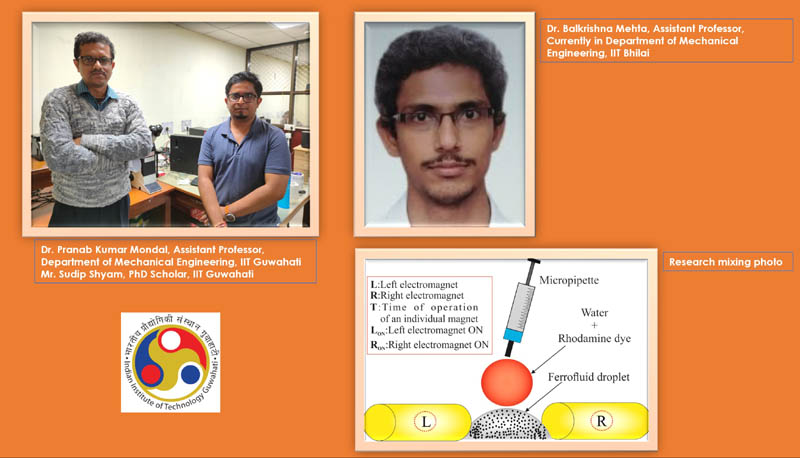
The research is carried out by Dr. Pranab Kumar Mondal, Assistant Professor, Department of Mechanical Engineering, IIT Guwahati, and his Ph.D. scholar Sudip Shyam, in collaboration with Dr. Balkrishna Mehta, (Presently at Department of Mechanical Engineering, IIT Bhilai), for exploring the species transport between droplets.
The research revealed that the mixing between two droplets can be attenuated significantly under the actuation of the magnetic field. This novel method showed a significant enhancement of around 80% in the overall mixing time between the droplets in comparison to the case where no external force is applied.
The research outcomes could be potentially beneficial in the area of biomedical diagnostics, whereby rapid and efficient mixing between fluids is of utmost importance.
In addition to that, this research also revealed that the magnetic field can be successfully used in altering the lifetime of a droplet containing suspended magnetic nanoparticles.
The research has shown that the evaporation rate of the droplet can be successfully controlled by varying the applied magnetic field frequency. The inferences drawn from this study could have far-reaching implications ranging from biomedical engineering to surface patterning.
Support Our Journalism
We cannot do without you.. your contribution supports unbiased journalism
IBNS is not driven by any ism- not wokeism, not racism, not skewed secularism, not hyper right-wing or left liberal ideals, nor by any hardline religious beliefs or hyper nationalism. We want to serve you good old objective news, as they are. We do not judge or preach. We let people decide for themselves. We only try to present factual and well-sourced news.
Support objective journalism for a small contribution.