 African Undervaccination
World must not blame Africa for undervaccination while denying continent shots, says expert
Washington/UNI/Sputnik: The international community should not be blaming African nations for being undervaccinated while at the same time limiting their access to vaccines, South African expert Solly Moeng told Sputnik.
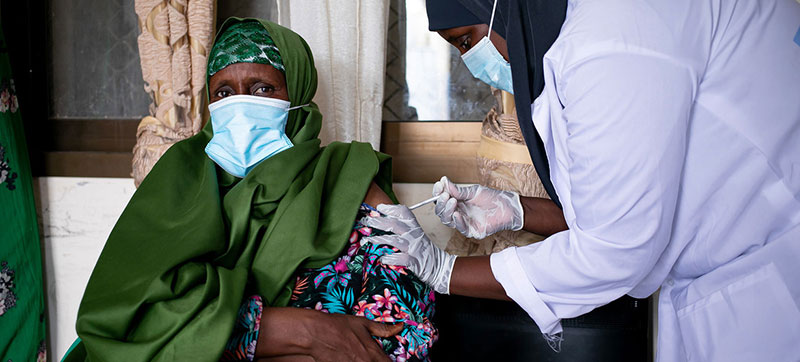
Last week, the World Health Organization raised concerns over the novel coronavirus Omicron variant that was first detected in South Africa. The development comes as Africa struggles with a low vaccination rate which the WHO estimates is 7.5 percent.
"Many of the African countries are struggling to get access to vaccines," Moeng, an Africa Brand Summit Convener, said. "The world can deny vaccines to Africa, and still blame Africans for not being sufficiently vaccinated, which is nonsense."
These developed countries, Moeng noted, have huge quantities of vaccines that developing states want to purchase but are being hampered from accessing. There is something wrong with this situation, and that needs to be said, he added.
Moeng believes the way the omicron announcement was made had a negative impact worldwide and damaged African economies. The scientists, he said, were unprepared - they likely thought it was important to announce the new virus strain as quickly as possible.
"The economic price paid by a lot of businesses in the tourism and hospitality travel sector is huge… it is serious," he said. "One has to weigh the potential ramifications of one's actions, irrespective of whether that action is good, is noble."
Moeng also said there was no clarity or coordination with the government and other structures working on this COVID pandemic in South Africa.
"If there was, there would be a team of trained professional communicators in there to advise them… because when you communicate very sensitive, potentially explosive stuff, you don't just go to the microphone or to the podium, speak and then go away," he said.
In addition, the reputation management adviser said they should know there is a level of prejudice against Africa - or anything coming from Africa.
"You can see how travel bans were imposed on South Africa and the neighbors, but not on the Netherlands or Germany or the UK or these other places where the same variant of COVID 19 was found," he added.
Moeng also said Africa on the whole has far fewer casualties from COVID-19 than the rest of the world, and stressed that South Africa still has restrictions in place, for example, on stadiums, where numbers are hugely controlled. Meanwhile, Moeng said he was told up to 2,000 people are allowed to go into stadiums in other countries.
"They're more careless than we are," he added. "So, I think there's a general prejudice against or a lack of trust of South African or African capabilities around the world, which is a pity. And I think these travel bans just show that the prejudice, the preconceived ideas are still there… that's a problem, this inequality."
Hence, a careful approach is necessary to avoid prompting the types of "knee jerk reactions" seen from several parts of the world, he said.
"We have to be careful and know that we live in a world where whatever we say might end up being interpreted in ways that we never, never expect because of who we are," Moeng said. "We don't have control over how the world responds to us, but we have control over how we say things or how we do things."
Support Our Journalism
We cannot do without you.. your contribution supports unbiased journalism
IBNS is not driven by any ism- not wokeism, not racism, not skewed secularism, not hyper right-wing or left liberal ideals, nor by any hardline religious beliefs or hyper nationalism. We want to serve you good old objective news, as they are. We do not judge or preach. We let people decide for themselves. We only try to present factual and well-sourced news.
Support objective journalism for a small contribution.