October 03, 2026 08:41 pm (IST)

Follow us:


WHO works on to contain Ebola outbreak in Guinea
New York, Apr 2 (IBNS): The number of suspected and confirmed cases of Ebola (EVD) in Guinea has jumped from 103 to 122 in just three days, with 80 confirmed deaths, said the United Nations World Health Organization (WHO), which will now focus on preventing further transmissions of the often fatal disease.
“The incubation period for all strains of Ebola is between two and 21 days,” said WHO spokesman Gregory Härtl, as he explained on Tuesday at a press briefing in Geneva that the agency has taken “the maximum incubation period and multiplied it by two to get the length of time needed to ensure no onwards transmission.”
“Communication with local communities and their education is of crucial importance,” he stressed.
According to WHO, the source of infection has been localized in the south east of Guinea. In Liberia, the seven infected – four of whom have died – are Liberians who had recently travelled to Guinea and were subsequently contaminated. The previously suspected Sierra Leone cases have been tested negative.
The Ebola virus first appeared in 1976 in two simultaneous outbreaks in Sudan and Democratic Republic of the Congo (DRC) and it does not normally cause a large number of cases – the largest outbreaks were of approximately 400 cases. However, with no treatment and no cure, it has a very high fatality rate of up to 90 per cent.
Ebola is introduced into the human population through close contact with the blood, secretions, organs or other bodily fluids of infected animals. In Africa, infection has been documented through the handling of infected chimpanzees, gorillas, fruit bats, monkeys, forest antelope and porcupines found ill or dead or in the rainforest.
Ebola then spreads in the community through human-to-human transmission, with infection resulting from direct contact (through broken skin or mucous membranes) with the blood, secretions, organs or other bodily fluids of infected people, and indirect contact with environments contaminated with such fluids.
Though smaller than past outbreaks in DRC and Uganda, the current Guinea Ebola cases fit the patterns of all previous outbreaks, said Härtl, explaining that the virus spread from the rural villages of the rainforest in the south east to the capital Conakry as the infected sought medical attention in the city.
Härtl stressed that in an outbreak the priority is stopping chain transmission and tracing all contacts. “The contacts need to be followed up for a period of 21 days and ensured against inadvertently spreading the disease to someone else,” he explained, adding that 11 health care workers have been confirmed as having contracted Ebola.
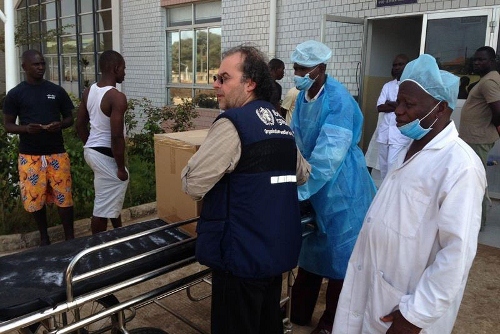
“WHO has been working both with Médecins sans Frontières and the Ministry of Health to ensure that the proper practices and equipment have been put in place to protect all these healthcare workers from the virus. Personal Protection Equipment has already been shipped, and more is on its way,” said Härtl.
He emphasized that, in public health terms, the current scope of the outbreak does not justify the use of the word “epidemic”. “The WHO is dealing with limited foci, limited geographical area and only a few chains of transmission,” he said.
For the time being, the UN health agency does not recommend any particular travel or trade restrictions.
(WHO delivers disposable personal protection equipment to isolation ward at the China-Guinea Friendship Hospital in Conakry, Guinea. Photo: WHO/T. Jasarevic)
Support Our Journalism
We cannot do without you.. your contribution supports unbiased journalism
IBNS is not driven by any ism- not wokeism, not racism, not skewed secularism, not hyper right-wing or left liberal ideals, nor by any hardline religious beliefs or hyper nationalism. We want to serve you good old objective news, as they are. We do not judge or preach. We let people decide for themselves. We only try to present factual and well-sourced news.
Support objective journalism for a small contribution.



Latest Headlines
From physiotherapy to AI, robotics: MRCCon 2026 highlights how medical rehabilitation has transformed in 27 years
Fri, Oct 02 2026
Study finds chewing tobacco linked to 2.5 lakh deaths worldwide; India among worst-affected countries
Fri, Oct 02 2026
Kolkata's Desun Hospital's Cardio Care Walkathon daws 200 participants on World Heart Day
Fri, Oct 02 2026
Insomnia is more than just sleepless nights: Study finds higher stroke, dementia risk
Tue, Sep 29 2026
Manipal Hospital Dhakuria hosts ‘Heart of Innovation Cardiac Summit’ ahead of World Heart Day
Mon, Sep 28 2026
Eating with your partner could lower blood sugar spikes, study finds
Sun, Sep 27 2026
The 10-hour weight-loss rule: What Johns Hopkins researchers discovered will leave obese, prediabetic patients happy?
Sun, Sep 27 2026
Loneliness could cost you nearly 6 healthy years, major study finds
Sun, Sep 27 2026
Common Add-ons That Improve Parents' Health Insurance Plans
Fri, Sep 25 2026