


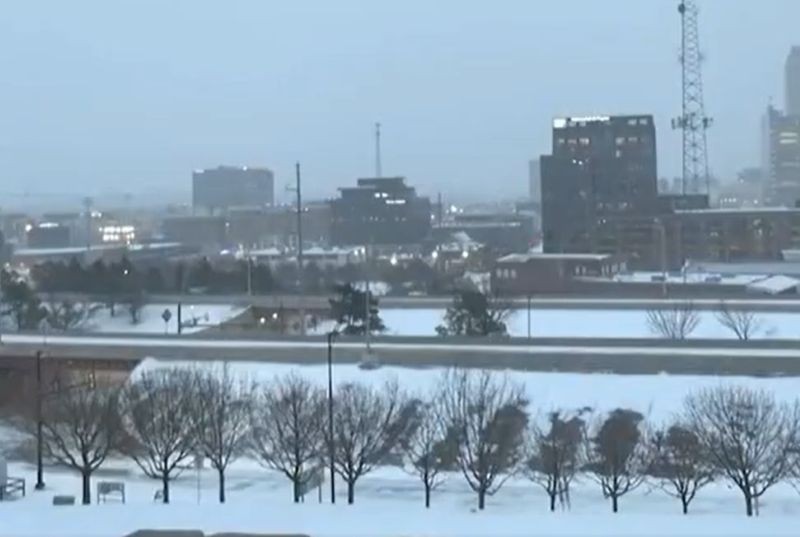
Thousands of flights cancelled as massive winter storm slams much of the US
A massive winter storm sweeping across the United States has triggered widespread travel disruptions, power outages and emergency measures, forcing the cancellation of thousands of flights and placing nearly half the country under weather warnings.
More than 140 million people, over 40 per cent of the US population, were under winter storm alerts stretching from New Mexico to New England on Saturday.
The National Weather Service warned of heavy snow, sleet, and freezing rain through Monday, followed by several days of dangerously cold temperatures.
Air travel was severely hit, with nearly 13,000 flights cancelled nationwide over Saturday and Sunday, according to FlightAware. Major airports, including Dallas-Fort Worth, Chicago, Atlanta, Nashville and Charlotte reported extensive disruptions.
Nearly all departing flights scheduled for Sunday from Washington’s Ronald Reagan National Airport were cancelled, while all flights were grounded at Oklahoma City’s Will Rogers International Airport through Sunday morning.
President Donald Trump approved emergency declarations for at least a dozen states as the storm intensified, with more expected.
The Federal Emergency Management Agency pre-positioned supplies, personnel and search-and-rescue teams across affected regions, Homeland Security Secretary Kristi Noem said, urging residents to remain indoors if possible.
Power outages mounted as ice-laden trees and downed power lines battered southern states. Around 120,000 customers were without electricity Saturday, including roughly 50,000 each in Texas and Louisiana.
In Shelby County, Texas, falling trees and snapped branches blocked roads and left about a third of residents without power.
Officials warned that ice accumulation posed an especially serious threat. New Jersey Governor Mikie Sherrill imposed restrictions on commercial vehicles and reduced highway speed limits, calling it “a good weekend to stay indoors.” Forecasters cautioned that damage in ice-hit regions could rival that of a hurricane.
Georgia officials advised residents in the northern parts of the state to stay off roads for at least 48 hours. State meteorologists warned the region could experience its most severe ice storm in more than a decade, followed by extreme cold.
Crews worked overnight treating highways with brine in an effort to reduce ice buildup.
After battering the South, the storm was expected to move into the Northeast, dumping up to two feet of snow in parts of Washington, New York and Boston. In the Midwest, wind chills plunged as low as minus 40 degrees Fahrenheit, raising the risk of frostbite within minutes.
Cities and institutions across the country shut down operations in response. Schools in Philadelphia and Houston announced closures for Monday, while universities in several southern states cancelled classes.
Churches moved services online, major events were called off, and Mardi Gras parades in Louisiana were postponed.
Despite the disruption, some residents made the most of the conditions, with sledders gathering on snowy hills in cities like Nashville.
Forecasters, however, warned that the storm’s vast geographic reach and the extreme cold expected in its wake make it one of the most unusual and dangerous winter systems in years.
Support Our Journalism
We cannot do without you.. your contribution supports unbiased journalism
IBNS is not driven by any ism- not wokeism, not racism, not skewed secularism, not hyper right-wing or left liberal ideals, nor by any hardline religious beliefs or hyper nationalism. We want to serve you good old objective news, as they are. We do not judge or preach. We let people decide for themselves. We only try to present factual and well-sourced news.
Support objective journalism for a small contribution.


