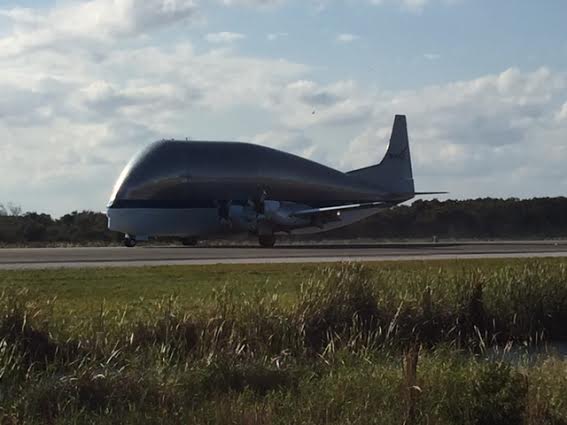
Orion crew module for Exploration Mission-1 arrives at NASA’s Kennedy Space Center
Arrival of the module marks an important milestone toward the agency’s journey to Mars.
The crew module arrived aboard the agency’s Super Guppy aircraft from NASA’s Michoud Assembly Facility in New Orleans. Welding work on the pressure vessel, which is the underlying structure of the crew module, was completed at Michoud, NASA said on its website.
The crew module was offloaded from the Super Guppy and readied for transport to the Neil Armstrong Operations and Checkout Building high bay for processing. In the high bay, NASA and Orion manufacturer Lockheed Martin will outfit the crew module with its systems and subsystems necessary for flight, including its heat-shielding thermal protection system.
NASA’s Space Launch System rocket will be the largest rocket ever built. It will carry the Orion spacecraft on EM-1, a test flight scheduled for 2018. During EM-1, Orion will travel thousands of miles beyond the moon over the course of a three-week mission.
Photo credit: NASA/Brittney Mostert
Support Our Journalism
We cannot do without you.. your contribution supports unbiased journalism
IBNS is not driven by any ism- not wokeism, not racism, not skewed secularism, not hyper right-wing or left liberal ideals, nor by any hardline religious beliefs or hyper nationalism. We want to serve you good old objective news, as they are. We do not judge or preach. We let people decide for themselves. We only try to present factual and well-sourced news.
Support objective journalism for a small contribution.