


 WHO
WHO
New WHO platform promotes global cancer prevention
New York: With one in five people worldwide developing cancer during their lifetimes, prevention of the disease has become one of the most significant public health challenges of the 21st century.
To mark World Cancer Day, the World Health Organization’s (WHO) International Agency for Research of Cancer (IARC) launched on Friday the World Code Against Cancer Framework, an online platform that will promote prevention globally and the development of Regional Codes to help fight the disease.
Based on current scientific evidence, at least 40 per cent of all cancer cases could be prevented with effective primary prevention measures, and further mortality can be reduced through early detection of tumours.
Regional differences
Dr. Carolina Espina, the IARC scientist who leads the project, explains that some risk factors are common worldwide, but some patterns are specific to certain regions and socioeconomic and cultural conditions.
Because of that, the new framework provides a common strategy and methodology to develop recommendations tailored to the context and needs of local populations.
The framework builds on the success of the fourth edition of the European Code Against Cancer.
“This new platform will host existing Regional Codes Against Cancer, such as the European Code…as well as Regional Codes that are currently under development, such as the Latin America and the Caribbean Code Against Cancer, and other future Regional Codes”,Dr.Espina explained.
The Latin America and the Caribbean Code Against Cancer is expected to be launched in 2023. It will be the first regional adaptation of the European Code Against Cancer.
Rays of Hope Initiative
Also on Friday, The International Atomic Energy Agency (IAEA) announced a new initiative, called Rays of Hope, to support Member States with diagnosis and treatment using radiation technologies, beginning with African countries most in need.
In a joint statement, the World Health Organization (WHO)Director-General, Tedros Adhanom Ghebreyesus, and the IAEA Director General, Rafael Mariano Grossi,explained how low and middle-income countries (LMICs) are disproportionately affected.
By 2040, over 70 per cent of cancer deaths are expected to occur in LMICs.
According to the two officials, recommended interventions for preventing cancer and other noncommunicable diseases have not been adequately implemented, and treatment remains inaccessible in many parts of the world.
“Globally, an estimated half of people diagnosed with cancer may require radiotherapy as part of their care, yet many countries do not have a single radiotherapy machine”, they say.
The disparity is particularly acute in Africa where nearly 70 per cent of countries reported that radiotherapy is generally unavailable.
The IAEA and WHO have a long-standing collaboration to support Member States to address their cancer burdens.
The organizations have successfully supported more than 90 governments through imPACT review missions, and through WHO cancer initiatives in cervical, childhood and breast cancers.
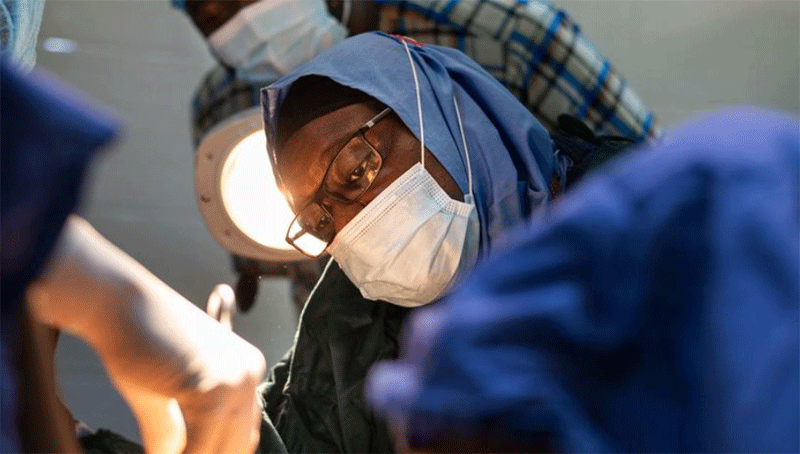
image:WHO/Blink Media/Etinosa Yvonn
Support Our Journalism
We cannot do without you.. your contribution supports unbiased journalism
IBNS is not driven by any ism- not wokeism, not racism, not skewed secularism, not hyper right-wing or left liberal ideals, nor by any hardline religious beliefs or hyper nationalism. We want to serve you good old objective news, as they are. We do not judge or preach. We let people decide for themselves. We only try to present factual and well-sourced news.
Support objective journalism for a small contribution.


