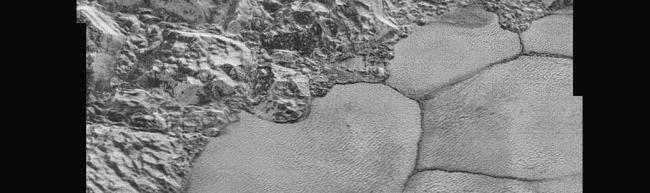
New Horizons' best close-Up of Pluto's surface
With a resolution of about 260 feet (80 meters) per pixel, the mosaic affords New Horizons scientists and the public the best opportunity to examine the fine details of the various types of terrain on Pluto, and determine the processes that formed and shaped them, read the NASA webiste.
“This new image product is just magnetic,” said Alan Stern, New Horizons principal investigator from Southwest Research Institute, Boulder, Colorado. “It makes me want to go back on another mission to Pluto and get high-resolution images like these across the entire surface.”
The view extends from the “limb” of Pluto at the top of the strip, almost to the “terminator” (or day/night line) in the southeast of the encounter hemisphere, seen below. The width of the strip ranges from more than 55 miles (90 kilometers) at its northern end to about 45 miles (75 kilometers) at its southern point. The perspective changes greatly along the strip: at its northern end, the view looks out horizontally across the surface, while at its southern end, the view looks straight down onto the surface.
This movie moves down the mosaic from top to bottom, offering new views of many of Pluto’s distinct landscapes along the way. Starting with hummocky, cratered uplands at top, the view crosses over parallel ridges of “washboard” terrain, chaotic and angular mountain ranges, cellular plains, coarsely “pitted” areas of sublimating nitrogen ice, zones of thin nitrogen ice draped over the topography below, and dark mountainous highlands scarred by deep pits.
The pictures in the mosaic were obtained by New Horizons’ Long Range Reconnaissance Imager (LORRI) approximately 9,850 miles (15,850 kilometers) from Pluto, about 23 minutes before New Horizons’ closest approach.
Credits: NASA/JHUAPL/SwRI
Support Our Journalism
We cannot do without you.. your contribution supports unbiased journalism
IBNS is not driven by any ism- not wokeism, not racism, not skewed secularism, not hyper right-wing or left liberal ideals, nor by any hardline religious beliefs or hyper nationalism. We want to serve you good old objective news, as they are. We do not judge or preach. We let people decide for themselves. We only try to present factual and well-sourced news.
Support objective journalism for a small contribution.