


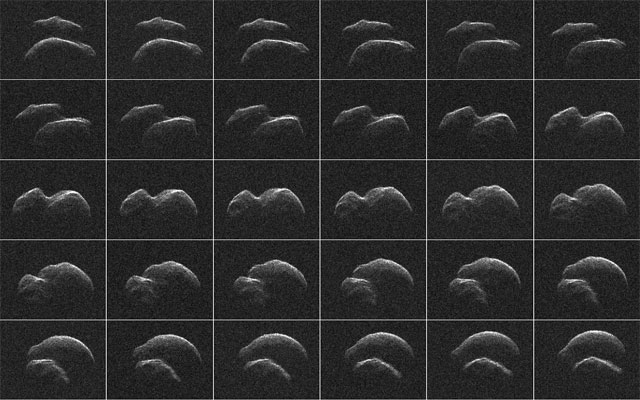
NASA radar spots relatively large Asteroid prior to flyby
The images reveal a peanut-shaped asteroid that rotates about once every five hours. The images have resolutions as fine as 25 feet (7.5 meters) per pixel.
Asteroid 2014 JO25 was discovered in May 2014 by astronomers at the Catalina Sky Survey near Tucson, Arizona -- a project of NASA's Near-Earth Objects Observations Program in collaboration with the University of Arizona.
The asteroid will fly safely past Earth on Wednesday at a distance of about 1.1 million miles (1.8 million kilometers), or about 4.6 times the distance from Earth to the moon.
The encounter is the closest the object will have come to Earth in 400 years and will be its closest approach for at least the next 500 years.
“The asteroid has a contact binary structure – two lobes connected by a neck-like region,” said Shantanu Naidu, a scientist from NASA's Jet Propulsion Laboratory in Pasadena, California, who led the Goldstone observations. “The images show flat facets, concavities and angular topography.”
The largest of the asteroid’s two lobes is estimated to be 2,000 feet (620 meters) across. Radar observations of the asteroid also have been conducted at the National Science Foundation's Arecibo Observatory in Puerto Rico. Additional radar observations are being conducted at both Goldstone and Arecibo on April 19 20, and 21, and could provide images with even higher resolution.
Radar has been used to observe hundreds of asteroids. When these small, natural remnants of the formation of the solar system pass relatively close to Earth, deep space radar is a powerful technique for studying
their sizes, shapes, rotation, surface features, and roughness, and for more precise determination of their orbital path.
NASA's Jet Propulsion Laboratory, Pasadena, California, manages and operates NASA's Deep Space Network, including the Goldstone Solar System Radar, and hosts the Center for Near-Earth Object Studies for NASA's Near-Earth Object Observations Program within the agency's Science Mission Directorate.
Image credit: NASA/JPL-Caltech/GSSR
Support Our Journalism
We cannot do without you.. your contribution supports unbiased journalism
IBNS is not driven by any ism- not wokeism, not racism, not skewed secularism, not hyper right-wing or left liberal ideals, nor by any hardline religious beliefs or hyper nationalism. We want to serve you good old objective news, as they are. We do not judge or preach. We let people decide for themselves. We only try to present factual and well-sourced news.
Support objective journalism for a small contribution.


