


More children killed by unsafe water, than bullets, says UNICEF chief
New York, Mar 22 (IBNS): A lack of safe water, is far deadlier for children than war in more than a dozen conflict-affected countries, the UN Children’s Fund (UNICEF) said on Thursday, in a report launched to coincide with World Water Day, marked on 22 March.
UNICEF’s 16-nation study into how water supplies effect children caught up in emergencies, also shows that children under-five are on average more than 20 times more likely to die from illnesses linked to unsafe water and bad sanitation, than from conflict.
“The odds are already stacked against children living through prolonged conflicts – with many unable to reach a safe water source,” said UNICEF Executive Director Henrietta Fore. “The reality is that there are more children who die from lack of access to safe water than by bullets."
According to the report, every year, 85,700 children under-15 die from diarrhoea linked to unsafe water, sanitation and hygiene facilities (WASH), compared with 30,900 from conflict.
Some 72,000 under-fives die annually from similar illnesses linked to WASH-access problems, compared to 3,400 from war-related violence.
UNICEF studied data from Afghanistan, Burkina Faso, Cameroon, the Central African Republic, Chad, the Democratic Republic of the Congo, Ethiopia, Iraq, Libya, Mali, Myanmar, Somalia, South Sudan, Sudan, Syria and Yemen.
It compared World Health Organization (WHO) mortality estimates for “collective violence” and “diarrhoeal disease”.
On average, mortality estimates were higher for diarrhoeal disease than violence in under 15-year-olds – except in Libya, Iraq and Syria.
Under-fives were more likely to die from diarrhoeal disease in all countries except Libya and Syria, the UN report found.
Children ‘always most vulnerable’
Hundreds of millions of youngsters live in areas afflicted by war, the UN agency said, noting that more countries are now embroiled internally and internationally than at any time in the past 30 years.
It highlights the fact that children “are always among the most vulnerable” and face a multitude of threats linked to a lack of safe water, sanitation and hygiene services.
These include malnutrition and preventable diseases including diarrhoea, typhoid, cholera and polio.
Girls especially vulnerable to sexual violence
Girls are particularly affected, UNICEF insists, warning that they face becoming victims of sexual violence as they collect water, or venture out to use latrines.
In addition, they struggle to manage menstrual hygiene and miss lessons during menstruation, if their schools have no suitable water and sanitation facilities, UNICEF notes.
Another consequence of armed conflict that people face is limited access to essential equipment and consumables, such as fuel or chlorine. These can be “depleted, rationed, diverted or blocked from delivery”, the agency noted earlier this year.
“Far too often, essential services are intentionally denied,” UNICEF said, citing how attacks on water networks “cut services for weeks at a time, forcing children to fetch water in extreme temperatures”.
As an example of the dangers faced, during a water crisis in Aleppo in the summer of 2015, three children were killed as they collected water for their families, the report noted.
Helping displaced Syrians near former ISIL stronghold
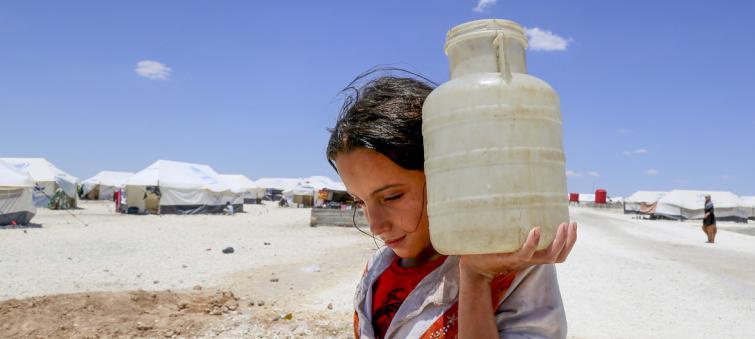
Today, the agency helps displaced Syrians by delivering trucked water to camps, including those near Raqqa, former bastion of the ISIL terrorist network.
Among those who have benefited is 12-year-old Horriya, who along with her family, made a three-day journey from Raqqa in 2017 to escape violence.
“I wasn’t afraid on the way,” Horriya says in the report. “We heard airplanes and shelling, but we’re used to that. We see them and hear them every day.”
UNICEF has also installed latrines, showers and water storage tanks in the camps and distributed family hygiene kits to protect children against waterborne diseases in camps including around Raqqa.
In 2018, UNICEF provided 35.3 million people with access to safe water for drinking, cooking and personal hygiene.
Image Credit: UNICEF/Souleiman
Support Our Journalism
We cannot do without you.. your contribution supports unbiased journalism
IBNS is not driven by any ism- not wokeism, not racism, not skewed secularism, not hyper right-wing or left liberal ideals, nor by any hardline religious beliefs or hyper nationalism. We want to serve you good old objective news, as they are. We do not judge or preach. We let people decide for themselves. We only try to present factual and well-sourced news.
Support objective journalism for a small contribution.


