


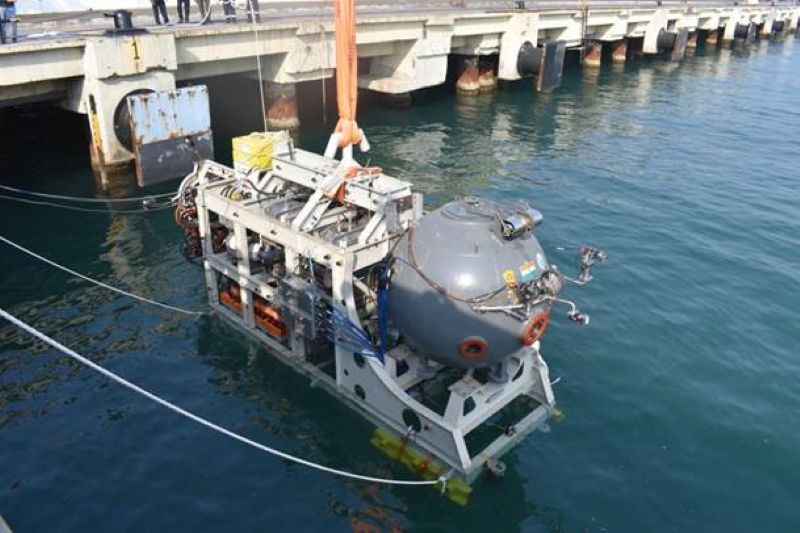
 Matsya-6000
Matsya-6000: India's Deep-Ocean Submersible completes wet testing
The Indian government has entrusted the National Institute of Ocean Technology with the task of designing and developing the 4th Generation deep-ocean human scientific submersible named "Matsya-6000," as part of the Samudrayan Project.
The wet testing of the submersible was successfully completed recently.
Deep Ocean Mission
The initiative was taken under the Government of India’s Deep Ocean Mission initiatives.
"This cutting-edge submersible is engineered to accommodate three humans within its compact 2.1-meter diameter spherical hull, marking a significant milestone in India's ocean exploration capabilities," read a statement issued by the Ministry of Earth Sciences.
Following the completion of the design phase, various subsystems vital to Matsya-6000's functionality were identified and developed.
The submersible features a comprehensive array of components: a main ballast system for diving, thrusters for movement in all three directions, a battery bank for power supply, and syntactic foam for buoyancy.
It also includes a sophisticated power distribution network, cutting-edge control hardware and software, along with advanced underwater navigation devices.
Communication systems include an acoustic modem, underwater telephone, and VHF for surface communication, supplemented by underwater acoustic positioning and GPS for precise surface location tracking.
Inside the spherical hull, careful attention has been given to the integration of human life-support systems, displays of various environmental/critical parameters, navigation joysticks for manoeuvrability, as well as various oceanographic sensors, underwater lighting and cameras outside the hull.
All these subsystems have been indigenously designed and are currently undergoing thorough integration and qualification testing.
To ensure a seamless integration of all systems within its exo-structure, the Matsya underwent a comprehensive series of integrated dry tests over a 500-meter operational range.
Following the successful completion of these tests, Matsya was transported to the L&T Shipbuilding facility located at Kattupalli Port, near Chennai during 27 Jan to 12 Feb, 2025 for conducting wet tests and demonstrating the submersible functionality.
Aim Of Test
The tests aimed to meticulously assess Matsya's performance across several critical parameters.
Evaluations focused on the robustness of power and control networks, floatation and stability of the vehicle, human support and safety systems, and manoeuvrability within limited degrees of freedom, specifically forward and reverse motion.
Additionally, navigation and communication capabilities were scrutinized.
The scientific payloads, which included multiple sophisticated oceanographic sensors, were thoroughly tested and demonstrated to confirm their intended functionality.
This demonstration phase featured eight dives in total, comprising five unmanned dives and five manned dives. Each manned dive was rigorously qualified, ensuring the reliability of the life support system.
Due to the restricted water depth in the harbour, underwater voice communication was less effective, highlighting the necessity for further testing at greater depths to enhance confidence in shallow-water operations.
In certain areas, additional efforts are needed to achieve optimal performance and completeness.
"Nevertheless, the successful wet test of the Matsya6000 at the harbour bolstered confidence for conducting shallow-water demonstrations at depths reaching up to 500 meters by the end of 2025," read a government statement.
Support Our Journalism
We cannot do without you.. your contribution supports unbiased journalism
IBNS is not driven by any ism- not wokeism, not racism, not skewed secularism, not hyper right-wing or left liberal ideals, nor by any hardline religious beliefs or hyper nationalism. We want to serve you good old objective news, as they are. We do not judge or preach. We let people decide for themselves. We only try to present factual and well-sourced news.
Support objective journalism for a small contribution.


