


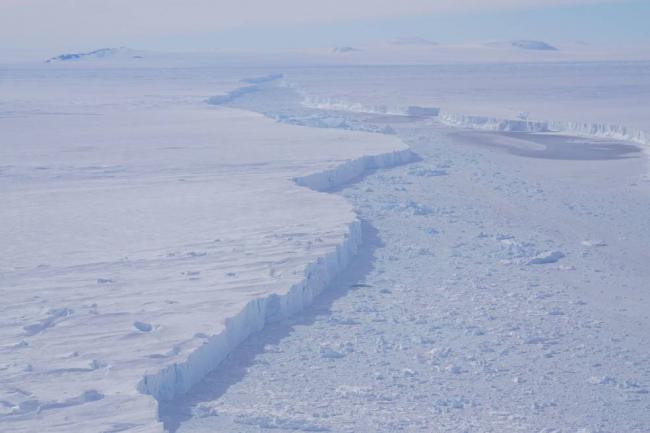
Massive Antarctic iceberg spotted on NASA IceBridge Flight
Washington, Nov 10 (IBNS): NASA’s Operation IceBridge on Wednesday, November 7, flew over an iceberg that is three times the size of Manhattan – the first time anyone has laid eyes on the giant iceberg, dubbed B-46 by the U.S. National Ice Center, that broke off from Pine Island Glacier in late October.
Wednesday's flight plan took the IceBridge team over Pine Island Glacier as part of the long-running campaign to collect year-over-year measurements of sea ice, glaciers, and critical regions of Earth's ice sheets, read the NASA website.
As NASA's DC-8 flew its pre-determined flight pattern, the new iceberg that calved in late October also came into view.
On October 29, the National Ice Center, which tracks icebergs for navigation purposes, estimated the surface area of B-46 at 66 square nautical miles, though satellite imagery and the IceBridge flight showed that the main iceberg is already beginning to break up.
Ice shelves, floating glacial ice areas that surround much of Antarctica, calve icebergs as part of the natural process of ice flowing out to sea.
But scientists are also watching closely to see if the frequency of calving events is changing over time. In late 2016, IceBridge saw a crack beginning across the ~ approximately 22 mile-wide trunk of Pine Island Glacier.
It took a year for the rift to fully form and the iceberg named B-44 to break away in September 2017. The crack that would become B-46 was first noticed in late September 2018 and the iceberg broke away about a month later.
Pine Island has now calved major icebergs in 2013, 2015, 2017, and 2018. Prior to that stretch, the glacier was experiencing major calving events about every six years.
Pine Island and nearby Thwaites Glacier alone are contributing about 1 millimeter per decade to global sea level rise, as their flow of ice to the sea has accelerated in recent years, according to NASA research.
Credits: NASA/ Brooke Medley
Support Our Journalism
We cannot do without you.. your contribution supports unbiased journalism
IBNS is not driven by any ism- not wokeism, not racism, not skewed secularism, not hyper right-wing or left liberal ideals, nor by any hardline religious beliefs or hyper nationalism. We want to serve you good old objective news, as they are. We do not judge or preach. We let people decide for themselves. We only try to present factual and well-sourced news.
Support objective journalism for a small contribution.


