


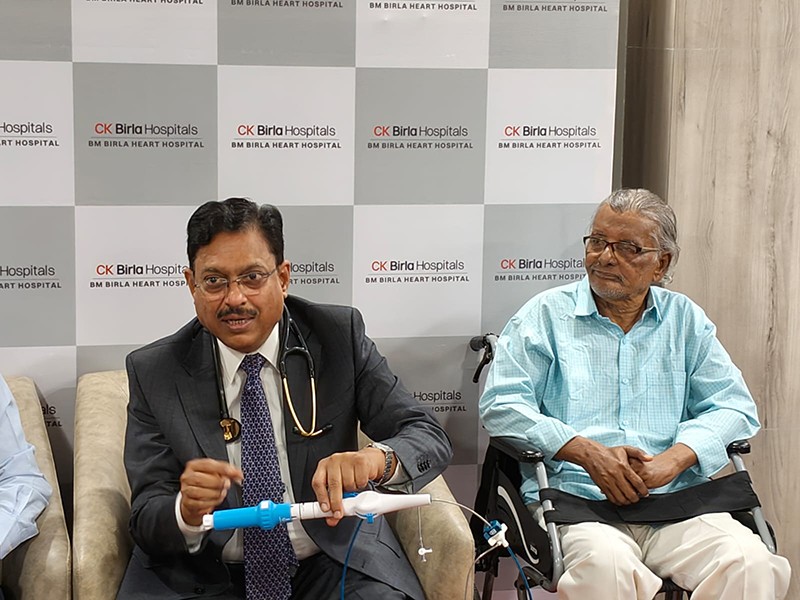
Kolkata: BM Birla Hospital conducts successful retrieval of 7-year-old leadless pacemaker in elderly patient
BM Birla Heart Research Centre has successfully retrieved a leadless pacemaker that had been implanted in a patient for more than seven years, marking what the hospital described as the first documented case in Southeast Asia, involving the extraction of a device of such long duration.
Dr. Anil Mishra, who performed the complex procedure, said the case represents another milestone for the institute’s cardiology department.
“At BM Birla, we have consistently introduced new techniques and achieved several firsts in the field of cardiology,” Mishra told reporters.
The elderly patient had a long and complicated cardiac history, compounded by multiple comorbidities, making the procedure particularly challenging.
“Leadless pacemakers were designed to minimise many of the complications associated with traditional transvenous systems. However, their long-term management continues to evolve,” Mishra explained.
He noted that retrieving a device implanted for several years can be technically demanding due to fibrotic encapsulation — a process in which scar tissue forms around the device, making extraction uncertain.
“When a device has been in place for an extended period, fibrotic fixation can make retrieval highly complex. Careful preparation is crucial — assessing the degree of fixation, anticipating potential complications, and ensuring pacing backup at every stage,” the doctor said.
The procedure required controlled traction, precise catheter manipulation and continuous haemodynamic monitoring throughout.
“These are not routine interventions. They demand a coordinated team,” Mishra added.
According to Mishra, there has been no prior documentation in India of a successful extraction of a leadless pacemaker beyond the early one-week post-implant period.
He said the patient has recovered well, with post-procedure imaging confirming satisfactory positioning and function, and added that the case provides renewed confidence to the medical community regarding the long-term use and management of leadless pacemakers.
“We now have greater assurance that we do not need to crowd the heart with multiple devices,” he said.
(Reporting by Supriyo Hazra)
Support Our Journalism
We cannot do without you.. your contribution supports unbiased journalism
IBNS is not driven by any ism- not wokeism, not racism, not skewed secularism, not hyper right-wing or left liberal ideals, nor by any hardline religious beliefs or hyper nationalism. We want to serve you good old objective news, as they are. We do not judge or preach. We let people decide for themselves. We only try to present factual and well-sourced news.
Support objective journalism for a small contribution.


