


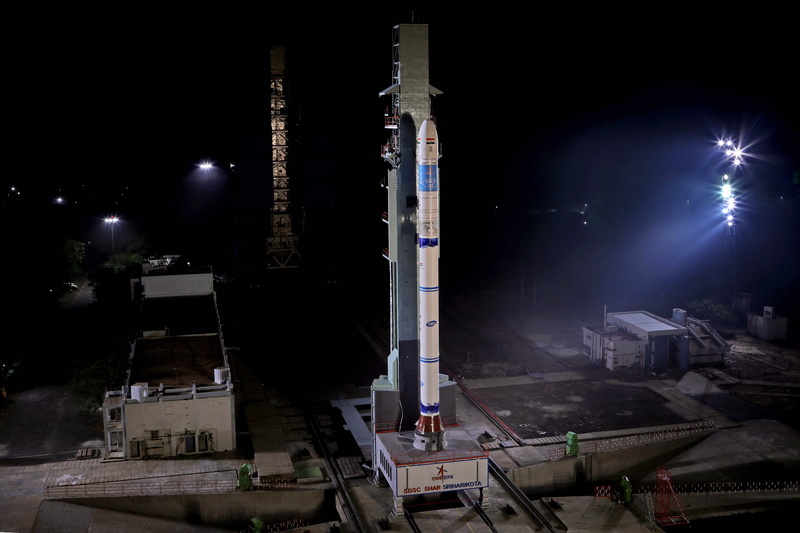
 Proba-3
ISRO set to launch ESA's Proba-3 mission on Nov 29 to create artificial eclipse
Bengaluru/IBNS: The European Space Agency's (ESA) Proba-3 mission has successfully passed its final test, paving the way for its shipment to India, where it will be launched by the Indian Space Research Organisation (ISRO) on November 29.
This mission, consisting of two satellites, is designed to create an artificial solar eclipse in space.
The recent test confirmed its operational capabilities, as the satellites responded to commands and transmitted images back, simulating their intended in-orbit performance.
Proba-3's innovative method involves two satellites flying in tight formation, with one satellite blocking the Sun’s disk from the other, creating a shadow.
This will enable extended observations of the Sun's corona, something that has been difficult to achieve with previous missions.
During a 12-hour test, a portion of Proba-3's 19.5-hour elliptical orbit around Earth was simulated.
The focus was on the six-hour period when the satellites will be at the farthest point from Earth (apogee), the critical time for formation flying and corona observation.
Commands were sent from the Royal Observatory of Belgium to ESA’s control center in Redu, which then transmitted them to the satellites housed in a cleanroom at Redwire Space in Kruibeke.
This final System Validation Test (SVT) was essential for confirming the mission's readiness, as it tested the ground segment facilities, software, and personnel who will manage the mission.
It also validated the process of sending commands for calibration, scientific observation, and real-time updates, ensuring flexibility for reacting to unexpected solar events.
Engineers stressed the importance of these tests to ensure smooth communication between the satellites and the ground team, highlighting the mission's highly automated systems.
With testing now complete, Proba-3 is set to be shipped to India’s Satish Dhawan Space Centre on October 21, ahead of its scheduled launch aboard a PSLV-XL rocket on November 29.
Proba-3 is the latest in ESA’s series of experimental minisatellites, pushing forward advancements in space technology and solar research.
Support Our Journalism
We cannot do without you.. your contribution supports unbiased journalism
IBNS is not driven by any ism- not wokeism, not racism, not skewed secularism, not hyper right-wing or left liberal ideals, nor by any hardline religious beliefs or hyper nationalism. We want to serve you good old objective news, as they are. We do not judge or preach. We let people decide for themselves. We only try to present factual and well-sourced news.
Support objective journalism for a small contribution.


