 Aditya-L1
ISRO assesses space situation around Earth Lagrange’s Point 1 to ensure Aditya-L1's safety
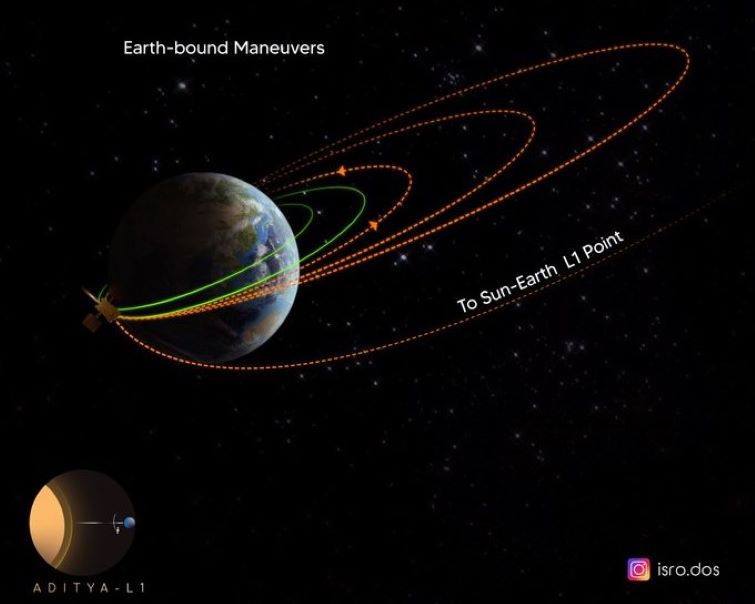
Chennai/IBNS: With Aditya-L1 spacecraft, India's first solar exploratory mission, continuing its journey towards the Sun-Earth Lagrange’s Point 1 (L1), the Indian Space Research Organisation (ISRO) on Tuesday assessed the space situation around L1 to ensure the safety of the spacecraft and avoid any possibility of close approaches with other neighbouring spacecrafts, with the support from NASA-JPL (Jet Propulsion Labortory).
Aditya-L1, India’s first mission dedicated to studying the Sun, was launched from the spaceport
of Sriharikota on Sept 2 and it embarked on its journey to L1 point on Sept 18 after completing its 16-day stay in earth orbit.
"ISRO's Aditya-L1 mission, launched on September 2, 2023, is India's first mission dedicated to studying the Sun, specifically the photosphere, chromosphere, and corona of the Sun. The spacecraft commenced its journey to its final destination, the Sun-Earth Lagrange’s Point 1 (L1), on September 18, 2023," ISRO said.
Lagrange points, also known as libration points, are unique locations in space where the gravitational force of two massive bodies (like the Sun and Earth) precisely equals the centripetal force required for a small object (like a spacecraft) to move with them.
This makes Lagrange Points an excellent location for spacecraft as orbit corrections and hence fuel requirements, needed to maintain the desired orbit, are kept at a minimum.
For any combination of two orbital bodies (like Sun-Earth and Earth-Moon systems), there are five Lagrange points (L1 to L5), all in the orbital plane of the two large bodies.
The three points - L1, L2, and L3 are dynamically unstable and lie on the line through the centres of the two large bodies, while the remaining two points - L4 and L5 are stable points and each acts as the third vertex of an equilateral triangle formed with the centres of the two large bodies.
Support Our Journalism
We cannot do without you.. your contribution supports unbiased journalism
IBNS is not driven by any ism- not wokeism, not racism, not skewed secularism, not hyper right-wing or left liberal ideals, nor by any hardline religious beliefs or hyper nationalism. We want to serve you good old objective news, as they are. We do not judge or preach. We let people decide for themselves. We only try to present factual and well-sourced news.
Support objective journalism for a small contribution.