 Milky Way
Indian scientists used data from more than 6,000 open clusters to map the dusty veil of Milky Way
Indian astronomers have mapped in detail the invisible layers of cosmic dust that veil our Milky Way and redden the light of the stars.
This may help trace the locations where the next generation of stars may be forming.
Our galaxy, the Milky Way, is filled with vast clouds of interstellar dust and gas that can block or dim the light from stars.
This is called ‘extinction’ of starlight, read a statement issued by the Indian government.
Understanding how the dust is spread across the Galaxy helps scientists learn more about where stars form and the structure of the Milky Way.
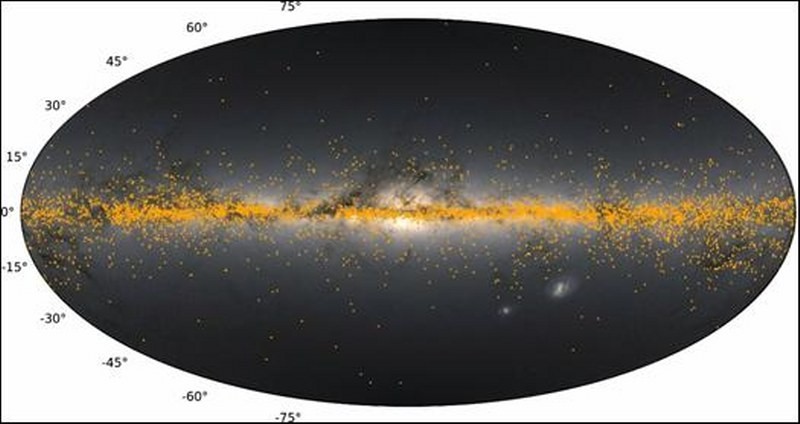
Scientists from Aryabhatta Research Institute of Observational Sciences (ARIES), an autonomous institute under the Department of Science and Technology, Govt. of India, used the data from more than 6,000 open clusters (a type of star clusters), to chart the distribution of this interstellar dust across the Milky Way's galactic plane or disk.
Most of these clusters lie close to the Galactic disk which is the thin plane of the Galaxy where interstellar matter is predominantly concentrated and star formation takes place.
Therefore, they act as reliable tracers for mapping the distribution of interstellar dust, which absorbs and dims their light.
Support Our Journalism
We cannot do without you.. your contribution supports unbiased journalism
IBNS is not driven by any ism- not wokeism, not racism, not skewed secularism, not hyper right-wing or left liberal ideals, nor by any hardline religious beliefs or hyper nationalism. We want to serve you good old objective news, as they are. We do not judge or preach. We let people decide for themselves. We only try to present factual and well-sourced news.
Support objective journalism for a small contribution.