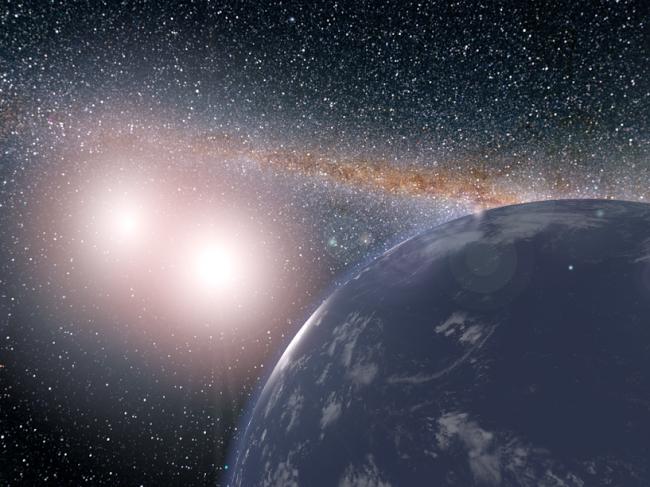
Illustration of an Earth-sized 'Tatooine' planet
In real life, thanks to observatories such as NASA's Kepler space telescope, we know that two-star systems can indeed support planets, although planets discovered so far around double-star systems are large and gaseous, read the NASA website.
Scientists wondered: If an Earth-size planet were orbiting two suns, could it support life?
It turns out, such a planet could be quite hospitable if located at the right distance from its two stars, and wouldn't necessarily even have deserts. In a particular range of distances from two sun-like host stars, a planet covered in water would remain habitable and retain its water for a long time, according to an April 6, 2017 study in the journal Nature Communications.
This illustration shows a hypothetical planet covered in water around the binary star system of Kepler-35A and B. In reality, the stellar pair Kepler-35A and B host a planet called Kepler-35b, a giant planet about eight times the size of Earth, with an orbit of 131.5 Earth days.
For their study, researchers neglected the gravitational influence of this planet and added a hypothetical water-covered, Earth-size planet around the Kepler-35 A and B stars.
They examined how this planet’s climate would behave as it orbited the host stars with periods between 341 and 380 days.
Image: NASA website
Support Our Journalism
We cannot do without you.. your contribution supports unbiased journalism
IBNS is not driven by any ism- not wokeism, not racism, not skewed secularism, not hyper right-wing or left liberal ideals, nor by any hardline religious beliefs or hyper nationalism. We want to serve you good old objective news, as they are. We do not judge or preach. We let people decide for themselves. We only try to present factual and well-sourced news.
Support objective journalism for a small contribution.