IIT Kharagpur develops COVID-19 predictive model, says disease likely to continue till September end
Kharagpur/IBNS: According to the COVID-19 predictive model devised by IIT Kharagpur, West Bengal, new cases of the disease will continue until at least the end of September.
The institution has developed this system to predict the future spread of COVID-19 and help decision making in health-care, industry, economy, and even academics.
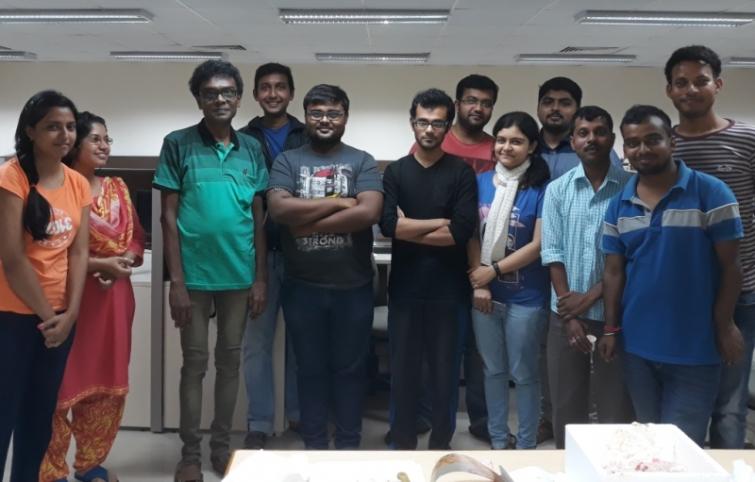
Prof. Abhijit Das from the Dept. of Computer Science and Engineering has developed this logistic model, which can be used to fit the available daily counts of infection cases.
The data used for the predictions pertain to the entire country, and for the eight most affected states in the country, including Maharashtra, Tami Nadu, Delhi, Gujarat, Uttar Pradesh, Rajasthan, West Bengal, and Madhya Pradesh.
Talking about the model development Prof. Das said, "The uses only the daily infection counts available in the public domain without accessing sensitive information pertaining to medical records or contact-tracing data for a large fraction of the population.
Despite that, the prediction curves show remarkably good fitting with the past data, and can be used for future planning."
Prof. Virendra Kumar Tewari, Director IIT Kharagpur said, " A study like this based on a clear statistical model will enable them to understand and plan their way forward. The model though experimental could prove to be helpful in planning our academic semester and policy matters related to the Institute and the campus under the current circumstances."
However, the predictions for the future change quite rapidly with time, the institution said in its release.
There are several potential factors for this such as different mobility patterns of Indian people in different phases of lockdown, large-scale migration of laborers, change in diagnostic facilities, evolution of the coronavirus, and so on.
These are well beyond the control of the logistic model or any other currently known prediction model for that matter, according to the release.
Although the implementation fails to generate stable and reliable predictions at the moment, the trend clearly reveals that the disease is going to stay in the country for many more months.
“Our study indicates that India is yet to achieve a steady pattern in the spread of the disease. It is unlikely to get rid of COVID-19 before the end of September 2020,” said Prof. Das.
He said, “This does not leave us in a region of comfort, but the reality has to be accepted, and appropriate plans must be chalked out to address all the issues associated with the outbreak of the pandemic."
Support Our Journalism
We cannot do without you.. your contribution supports unbiased journalism
IBNS is not driven by any ism- not wokeism, not racism, not skewed secularism, not hyper right-wing or left liberal ideals, nor by any hardline religious beliefs or hyper nationalism. We want to serve you good old objective news, as they are. We do not judge or preach. We let people decide for themselves. We only try to present factual and well-sourced news.
Support objective journalism for a small contribution.