

 Vietnam
Forensic lab aids crack down on illegal wildlife trade in Viet Nam
New York: Despite travel bans and other COVID-19 restrictions, the small team at Viet Nam’s wildlife forensic lab has been bolstering police efforts to crack down on illegal trafficking, with support from the UN Office on Drugs and Crime (UNODC).
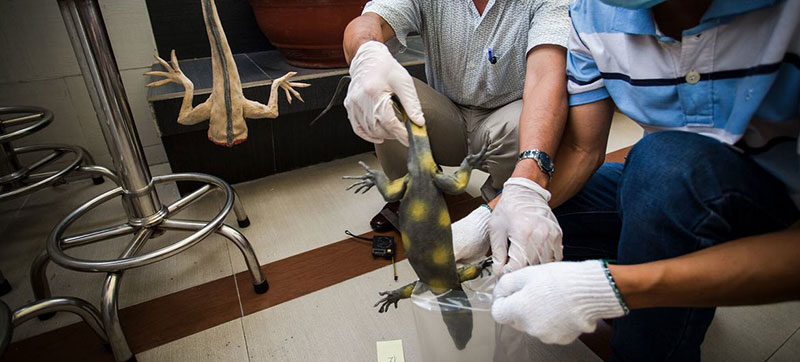
The limited research lab worked on almost 250 criminal cases last year, representing hundreds of individual samples from high-profile cases related to rhino horns, pangolin scales, elephant ivory, big cats, fish, bear parts, turtles and lion bones.
Lab upgrade
The facility is based at the Institute of Ecology and Biological Resources (IEBR), located in the capital, Hanoi, and has undergone a major transformation.
It has now become a world-class wildlife forensic laboratory, through funding provided initially by the United States Agency for International Development (USAID) and, more recently, UNODC.
Giovanni Broussard, Regional Coordinator for the UN agency’s Global Programme for Combating Wildlife and Forest Crime, recently announced continued funding through September.
“Despite the continuous challenges, the Viet Nam laboratory has continued to operate effectively and was given special permission to operate during lockdowns, clearly demonstrating the commitment of the Vietnamese Government to tackle the illegal wildlife trade,” he said.
Supporting law enforcement
The six dedicated forensic staff worked through pandemic restrictions, including local travel bans, to ensure criminal cases were processed and reported efficiently.
The project funded by UNODC, and implemented by TRACE Wildlife Forensic Network, directly supported more than 70 criminal cases through a specialized quality management system.
Last July, customs authorities at the port in Da Nang seized a cargo shipment sent from Durban, South Africa. The shipment had been declared as wood, but actually contained just over three tonnes of animal bones, including skulls and 52 horns.
Bone samples
Although staff were prevented from travelling to the crime scene due to COVID-19 restrictions, they provided a sampling guide so that customs officers could take one bone from each bag, and extract a sample of each horn, which were then sent back to the IEBR for analysis.
Regional technical support specialist, Kelly Morgan from TRACE Wildlife Forensic Network, said “it’s been a challenging two years, but the transformation is incredible to witness.”
The lab is currently undergoing an audit by the US-based Society of Wildlife Forensic Science to ensure that the work practices are consistent with international standards.
Support Our Journalism
We cannot do without you.. your contribution supports unbiased journalism
IBNS is not driven by any ism- not wokeism, not racism, not skewed secularism, not hyper right-wing or left liberal ideals, nor by any hardline religious beliefs or hyper nationalism. We want to serve you good old objective news, as they are. We do not judge or preach. We let people decide for themselves. We only try to present factual and well-sourced news.
Support objective journalism for a small contribution.