Ebola response panel studying ways to enforce compliance with key UN legal health instrument
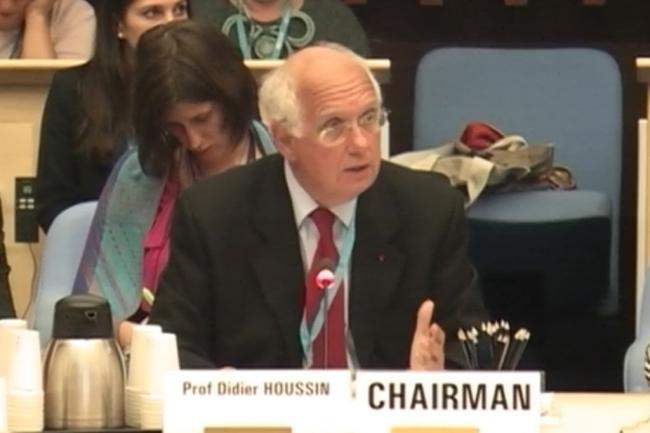
“In many countries, even in the Ministry of Health… sometimes the regulations about the International Health Regulations are not well known, so I think that there is a question of information communication, there is a question of capacities, there is a question of compliance to the rules; that’s very important,” said Didier Houssin, newly-elected Chair of the Review Committee on the Role of International Health Regulations in the Ebola Outbreak and Response.
The 68th World Health Assembly in May 2015 set a mandate for a Review Committee on response to the Ebola outbreak, which has claimed more than 11,300 lives to date mostly in Guinea, Liberia and Sierra Leone, to recommend steps to improve the functioning, transparency, effectiveness and efficiency of the regulations, and to strengthen preparedness and response for future emergencies with health consequences.
In a press conference after the committee’s two-day meeting in Geneva, Switzerland, Houssin said the review will divided by three working groups – one on communications to define the flow of information from the World Health Organization (WHO) to member States, a second to address capacities, epidemiology, points of entry, surveillance and a third to evaluate member states’ compliance to rules and governance of international health regulations.
“The International Health Regulations…are a very important legal instrument in order to improve the global health security; that’s an instrument for public health to protect the health of the population in the world and it’s existing since several decades and it has been modified in 2005,” Houssin said. “And, of course, it has strengths and weaknesses and, recently, the Ebola outbreak suggested that probably there were things to improve in these Regulations.”
He said the committee requested from the WHO to inform it about the various methods of compliance which can be used in international laws, Houssin said.
“In some sectors, for example, there is almost no imposition, nothing imperative; for example, human rights,” he said. “On the other hand, you have, at the other extreme, weapons and nuclear activities where there are sanctions, controls [and] inspections. Well, with the International Health Regulations there is no sanction but we observe that there is not a good compliance.”
“So, we have to find the right balance and probably encouraging mechanisms, incentives, publicity, transparency, benchmarking are the ways that we will explore but at this stage it’s too early to say what will be our recommendation,” he said.
“We are going to explore all the possibilities,” he said.
He said the recommendations are expected to be presented to the next World Health Assembly that is in May 2016.
In her opening address to the committee, WHO Director-General Dr. Margaret Chan said on Monday that “the aftermath of the Ebola outbreak likely represents our best chance ever to transform the world’s response to epidemics and other health emergencies.”
Photo: WHO Webcast video capture
Support Our Journalism
We cannot do without you.. your contribution supports unbiased journalism
IBNS is not driven by any ism- not wokeism, not racism, not skewed secularism, not hyper right-wing or left liberal ideals, nor by any hardline religious beliefs or hyper nationalism. We want to serve you good old objective news, as they are. We do not judge or preach. We let people decide for themselves. We only try to present factual and well-sourced news.
Support objective journalism for a small contribution.