


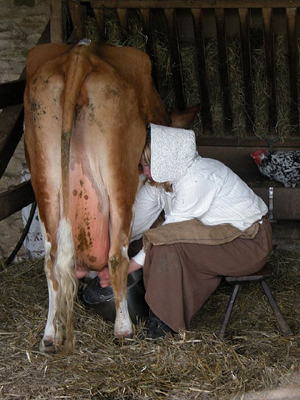
Drinking raw cow milk increases risk for foodborne illness
"Consumers are nearly 100 times more likely to get foodborne illness from drinking raw milk than they are from drinking pasteurized milk. In fact, the researchers determined that raw milk was associated with over half of all milk-related foodborne illness, even though only an estimated 3.5% of the U.S. population consumes raw milk," CLF said in a statement.
Based on their findings, the researchers discourage the consumption of raw milk, which some claim is healthier and tastes better than pasteurized milk.
They note that the risks are better understood than the benefits, and that further research is needed to determine whether the health benefit claims are legitimate.
The CLF analysis was prepared at the request of the Maryland House of Delegates’ Health and Operations Committee as lawmakers considered relaxing regulations that currently prohibit the sale of unpasteurized milk in Maryland.
In the 2014 legislative session, House Bill 3 aimed to legalize the on-farm sale of unpasteurized milk in Maryland. The bill was tabled as legislators considered the issue. The research team presented its report to the House of Delegates last month.
Raw milk has become more popular in recent years, even though it is only available for direct purchase at farms in many states.
Advocates believe that raw milk, which contains more natural antibodies, proteins and bacteria than pasteurized milk, is healthier, cleaner, tastes better and reduces lactose intolerance and allergies in certain people. Pasteurization, named after Louis Pasteur, involves heating milk to destroy microbes that may have entered the milk supply from fecal contamination, dairy operations, cow udders or other sources.
The treated milk is then hermetically sealed to prevent recontamination.
“Ultimately, the scientific literature showed that the risk of foodborne illness from raw milk is over 100 times greater than the risk of foodborne illness from pasteurized milk,” says report lead author, Benjamin Davis, a CLF-Lerner Fellow and doctoral candidate in the Johns Hopkins Bloomberg School of Public Health’s Department of Environmental Health Sciences. “Although potential benefits related to the consumption of raw milk would benefit from further investigation, we believe that from a public health perspective it is a far safer choice to discourage the consumption of raw milk.”
For their study, a team of investigators led by Keeve Nachman, PhD, director of the Public Health and Food Production Program at CLF and an assistant professor with the Bloomberg School, screened approximately 1,000 articles and reviewed 81 published journal articles relevant to the health risks and benefits of consuming raw cow’s milk.
Microbial contaminants commonly found in milk include infectious Salmonella, Campylobacter, and Listeriaspecies along with the Escherichia coli type O157:H7. These bacteria can cause foodborne illness in humans, including diarrhea, vomiting, cramping, fevers, and sometimes more serious consequences such as kidney failure or death.
“The risks of consuming raw milk instead of pasteurized milk are well established in the scientific literature, and in some cases can have severe or even fatal consequences,” notes co-author Cissy Li, a CLF research assistant and doctoral candidate with the Bloomberg School’s Department of Environmental Health Sciences. “Based on our findings, we discourage the consumption of raw milk, especially among vulnerable populations such as the elderly, people with impaired immune systems, pregnant women, and children.”
Support Our Journalism
We cannot do without you.. your contribution supports unbiased journalism
IBNS is not driven by any ism- not wokeism, not racism, not skewed secularism, not hyper right-wing or left liberal ideals, nor by any hardline religious beliefs or hyper nationalism. We want to serve you good old objective news, as they are. We do not judge or preach. We let people decide for themselves. We only try to present factual and well-sourced news.
Support objective journalism for a small contribution.


