 ISRO
ISRO
Chandrayaan-3: Rambha payload finds sparse plasma in Lunar area
The Indian Space Research Organisation (ISRO) on Friday said that Vikram Lander on board the Chandrayaan-3 spacecraft, the third Lunar Mission, has detected plasma in the south polar region of the Moon.
The Radio Anatomy of Moon Bound Hypersensitive Ionosphere and Atmosphere-Langmuir Probe (RAMBHA-LP) payload onboard Chandrayaan-3 Lander has made the first-ever measurements of the near-surface Lunar plasma environment over the south polar region.
In an update, ISRO posted on X: "Radio Anatomy of Moon Bound Hypersensitive Ionosphere and Atmosphere - Langmuir Probe (RAMBHA-LP) payload onboard Chandrayaan-3 Lander has made first-ever measurements of the near-surface Lunar plasma environment over the south polar region."
Chandrayaan-3 Mission:
— ISRO (@isro) August 31, 2023
In-situ Scientific Experiments
Radio Anatomy of Moon Bound Hypersensitive Ionosphere and Atmosphere - Langmuir Probe (RAMBHA-LP) payload onboard Chandrayaan-3 Lander has made first-ever measurements of the near-surface Lunar plasma environment over the… pic.twitter.com/n8ifIEr83h
"The initial assessment indicates that the plasma near the lunar surface is relatively sparse," the Indian Space Agency said.
"These quantitative measurements potentially assist in mitigating the noise that Lunar plasma introduces into radio wave communication. Also, they could contribute to the enhanced designs for upcoming lunar visitors," read the statement.
The RAMBHA-LP payload is a Langmuir probe that was developed by the Space Physics Laboratory (SPL) of the Vikram Sarabhai Space Centre (VSSC) in Thiruvananthapuram.
It was onboard the Chandrayaan-3 lander, which successfully landed on the Moon's surface on August 23, 2023.
The RAMBHA-LP payload is designed to make in-situ measurements of the near-surface lunar plasma environment.
This is the region of space that is closest to the Moon's surface, and it is where the lunar plasma is most dense.
The RAMBHA-LP payload will measure the electron density, temperature and electric field in the near-surface lunar plasma environment.
The initial assessment of the data from the RAMBHA-LP payload indicates that the plasma near the lunar surface is relatively sparse.
This means that there are not many electrons in this region of space.
Also Read: Chandrayaan-3: Pragyan Rover detects sulphur on Moon
The sparseness of the lunar plasma is important because it affects the way that radio waves propagate through space.
Radio waves are affected by the presence of plasma, and the more dense the plasma, the more the radio waves are scattered.
The sparseness of the lunar plasma means that radio waves can propagate through space with less attenuation, which is important for communication between lunar missions.
The measurements from the RAMBHA-LP payload will help scientists to better understand the near-surface lunar plasma environment.
This understanding will be important for the design of future lunar missions. For example, the measurements from the RAMBHA-LP payload
could be used to design antennas that are more efficient at transmitting and receiving radio waves in the lunar environment.
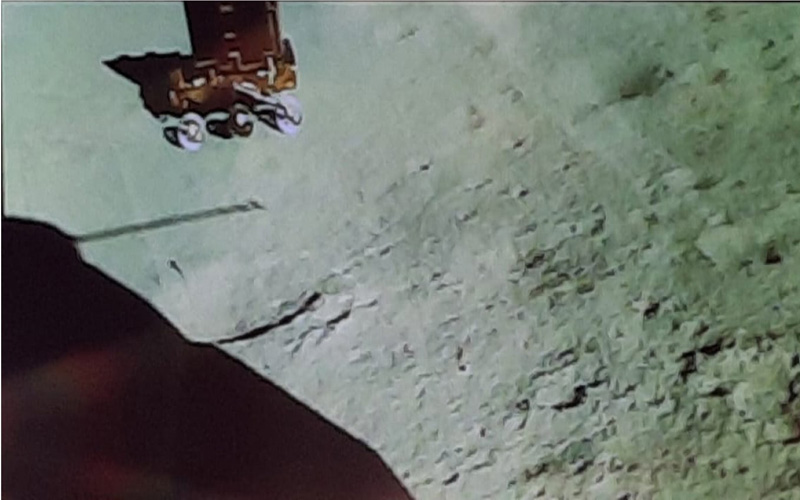
ISRO also announced that the Chandrayaan-3 In-situ Scientific Experiments revealed that Instrument for the Lunar Seismic Activity (ILSA) payload on Lander -- the first Micro Electro Mechanical Systems (MEMS) technology-based instrument on the moon -- has recorded the movements of Rover and other payloads.
Additionally, it has recorded an event, appearing to be a natural one, on August 26, 2023.
The source of this event is under investigation.
ILSA payload is designed and realised LEOS, Bangalore. The deployment mechanism is developed by URSC, Bengaluru.
Support Our Journalism
We cannot do without you.. your contribution supports unbiased journalism
IBNS is not driven by any ism- not wokeism, not racism, not skewed secularism, not hyper right-wing or left liberal ideals, nor by any hardline religious beliefs or hyper nationalism. We want to serve you good old objective news, as they are. We do not judge or preach. We let people decide for themselves. We only try to present factual and well-sourced news.
Support objective journalism for a small contribution.