Cassini sees dramatic seasonal changes on Titan
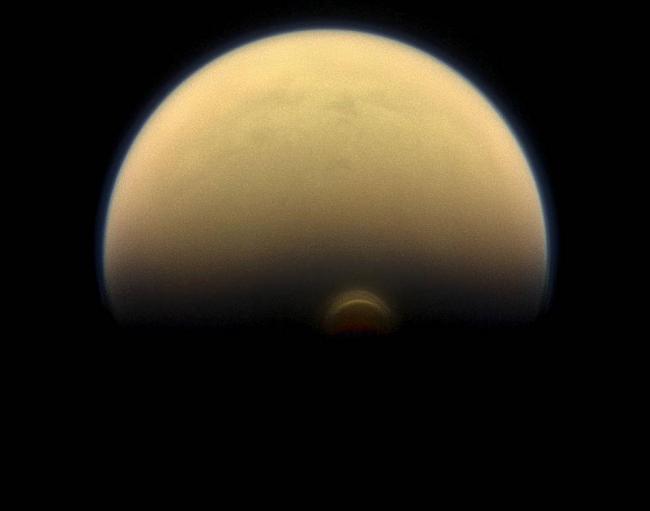
Winter is taking a grip on Titan's southern hemisphere, and a strong, whirling atmospheric circulation pattern -- a vortex -- has developed in the upper atmosphere over the south pole. Cassini has observed that this vortex is enriched in trace gases -- gases that are otherwise quite rare in Titan's atmosphere.
Cassini's observations show a reversal in the atmosphere above Titan's poles since the spacecraft arrived at Saturn in 2004, when similar features were seen in the northern hemisphere, read thee NASA website.
"Cassini’s long mission and frequent visits to Titan have allowed us to observe the pattern of seasonal changes on Titan, in exquisite detail, for the first time," said Athena Coustenis, a member of Cassini's Composite Infrared Spectrometer team at the Observatoire de Paris. Coustenis is presenting the team's findings at the joint 48th meeting of the American Astronomical Society Division for Planetary Sciences and 11th European Planetary Science Congress (EPSC), this week in Pasadena, California. "We arrived at the northern mid-winter and have now had the opportunity to monitor Titan's atmospheric response through two full seasons."
Heat is circulated through Titan's atmosphere via a pole-to-pole cycle of warm gases upwelling at the summer pole and cold gases subsiding at the winter pole. Cassini's observations have shown a large-scale reversal of this system, beginning immediately after the equinox in 2009.
Titan's hemispheres have responded in different ways to these seasonal changes. The wintry effects have led to a temperature drop of 72 degrees Farenheit (40 degrees Celsius) in the southern polar stratosphere over the last four years. This contrasts with a much more gradual warming in the northern hemisphere, where temperatures remained stable during the early spring and have shown just a six-degree increase since 2014.
Within months following the equinox, the vortex in the stratosphere over the south pole had become prominent, as had an atmospheric "hot spot" at high altitudes. The corresponding features in the northern hemisphere had almost disappeared by 2011.
Inside the polar vortex over the increasingly shadowed south pole, there has been a rapid build-up of trace gases that accumulate in the absence of ultraviolet sunlight. These include complex hydrocarbons previously only seen at high northern latitudes.
Image Credits: NASA/JPL-Caltech/Space Science Institute
Support Our Journalism
We cannot do without you.. your contribution supports unbiased journalism
IBNS is not driven by any ism- not wokeism, not racism, not skewed secularism, not hyper right-wing or left liberal ideals, nor by any hardline religious beliefs or hyper nationalism. We want to serve you good old objective news, as they are. We do not judge or preach. We let people decide for themselves. We only try to present factual and well-sourced news.
Support objective journalism for a small contribution.