 Obesity
Can warning labels and ad bans beat childhood obesity? Landmark study says yes
A comprehensive package of food policies implemented in Chile has been linked to a measurable reduction in the risk of overweight and obesity among young children, according to a study published in The Lancet.
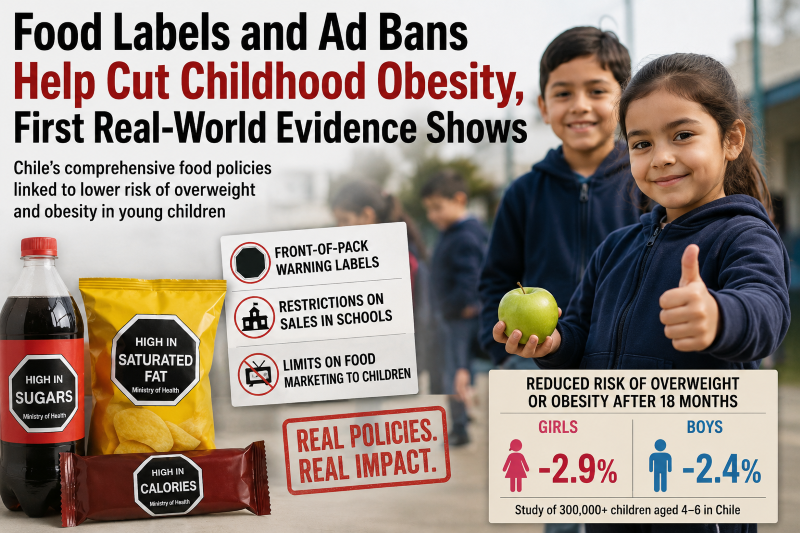
Chile, which has one of the world's highest rates of childhood overweight and obesity, introduced the Food Labelling and Advertising Law (FLAL) in 2016 to address the growing public health challenge. The law combines three key measures: mandatory front-of-package warning labels on foods high in sugar, saturated fat, salt, or calories; restrictions on the sale of such products in schools; and limits on marketing unhealthy foods to children.
Researchers analysed national data from more than 300,000 Chilean schoolchildren aged four to six years and compared obesity and overweight rates before and after the implementation of the law's first phase.
The findings suggest that children exposed to the policy for 18 months were significantly less likely to be overweight or obese than their counterparts before the law came into effect. Among girls, the risk fell by 2.9%, while boys experienced a 2.4% reduction. Positive effects were also observed after just six months of exposure to the policy.
"This is the first study to plausibly demonstrate that a package of food policies can reduce childhood overweight and obesity risk at the national level," said Professor Guillermo Paraje of Universidad Adolfo Ibáñez Business School in Chile. He noted that the results provide strong evidence supporting mandatory nutrition warning labels, restrictions on unhealthy food sales in schools, and marketing bans as practical tools for tackling childhood obesity.
The study assessed only the first phase of the legislation. Subsequent phases introduced in 2018 and 2019 imposed even stricter nutritional thresholds, suggesting that the long-term impact could be greater than reported in the current analysis.
Researchers acknowledged certain limitations, including reliance on observational data and school-based measurements. However, they said the findings provide compelling real-world evidence that comprehensive food policy interventions can improve children's health outcomes.
In an accompanying comment, independent experts from The George Institute for Global Health in Australia described the study as an important contribution to the evidence base, arguing that governments should move beyond isolated measures and adopt integrated strategies combining warning labels, marketing restrictions and school food standards to create healthier food environments for children.
Support Our Journalism
We cannot do without you.. your contribution supports unbiased journalism
IBNS is not driven by any ism- not wokeism, not racism, not skewed secularism, not hyper right-wing or left liberal ideals, nor by any hardline religious beliefs or hyper nationalism. We want to serve you good old objective news, as they are. We do not judge or preach. We let people decide for themselves. We only try to present factual and well-sourced news.
Support objective journalism for a small contribution.