Birmingham scientists to observe brightest stars in sky, NASA to launch new observatory into space
Washington, Apr 16 (IBNS): NASA’s Transiting Exoplanet Survey Satellite (TESS) will be launched from Cape Canaveral in Florida on Monday.
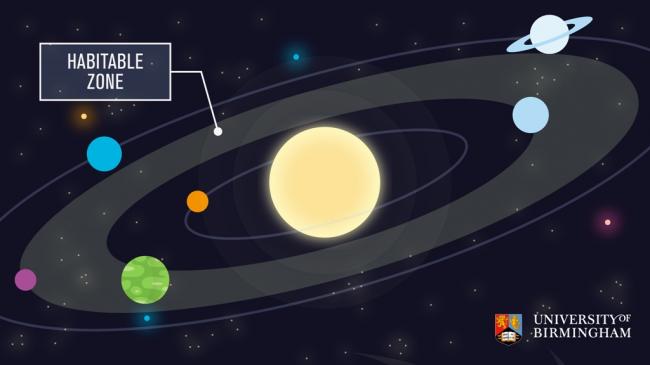
TESS will survey the brightest stars in the sky to search for planets orbiting stars and to also study the stars themselves. Birmingham physicists are playing a leading role internationally in the asteroseismology programme of TESS; the study of stars by observing their resonant oscillations, which are caused by sound trapped inside the stars. By measuring the tones of this ‘stellar music’, it is possible to determine the properties of individual stars in exquisite detail.
Professor Bill Chaplin, from the University of Birmingham’s School of Physics and Astronomy, is leading the international work that will characterise bright, newly discovered exoplanet host stars – and hence their planets – using asteroseismology.
Professor Chaplin said: “Perhaps the most exciting results from TESS are going to be from the brightest stars in the sky, which we can observe at night with the naked eye. There will be stars with well-known names around which TESS discovers planets - we will be able to study them in unprecedented detail.
“Previous space missions dedicated to these studies have not looked at anything like the amount of sky TESS will cover, nor have they observed stars as bright at this. On a clear night we will be able to point out these newly discovered stellar systems directly by hand.’
The mission will produce results by the end of 2018.
Support Our Journalism
We cannot do without you.. your contribution supports unbiased journalism
IBNS is not driven by any ism- not wokeism, not racism, not skewed secularism, not hyper right-wing or left liberal ideals, nor by any hardline religious beliefs or hyper nationalism. We want to serve you good old objective news, as they are. We do not judge or preach. We let people decide for themselves. We only try to present factual and well-sourced news.
Support objective journalism for a small contribution.