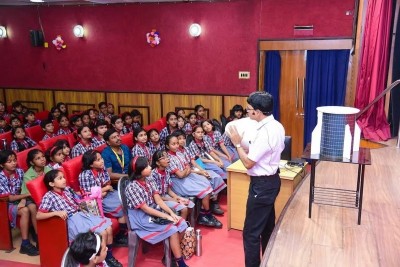
Birmingham scientists launch project to tackle global 'clean cold' challenge
The 17 ‘Global Goals’ commit the international community to put the world to rights by 2030 - abolishing poverty and hunger; providing good healthcare and education; raising people’s quality of life; and cleaning up the environment, whilst promoting economic growth.
Professor Toby Peters and colleagues at the Birmingham Energy Institute aim to work with partners in countries where demand for ‘clean cold’ is soaring, such as India and China. They will develop strategies using novel low-carbon and zero-emission technologies and new policy approaches.
The roadmaps they produce could provide a global template to help meet the UN targets, as demand for cooling booms in fast growing economies - largely driven by urbanisation and emergence of an Asian Pacific middle class – predicted to rise to 3 billion by 2030 – with lifestyles built on cooling.
Professor Toby Peters said: “Cooling is a huge problem faced by India, China and other fast-growing economies. It is all too often overlooked, but without it, supplies of food, medicine and even data break down; life in many parts of the world would be scarcely tolerable without air conditioning."
“The University of Birmingham is a world-leader in ‘clean cold’ expertise. We look forward to working with experts around the globe to tackle the challenge of supporting growing populations without causing environmental or societal damage. A huge research effort is now under way into how to realise the Global Goals and many linkages, such as economic growth and pollution are well understood. It is now becoming clear that cooling will be critical to achieving almost all the UN’s Global Goals,” said Peters.
The report highlights that, as the world’s population heads to 9 billion by mid-century - increasing projected food demand by 60% - we will need far more cooling to conserve food, water and other resources; tackle poverty, hunger, health and climate change; and underpin growth and development.
It will be vital that any new cold chain infrastructure should be clean. Diesel-powered transport refrigeration units, for example, emit not only high levels of CO2 but also huge amounts of nitrogen oxides (NOx) and particulate matter (PM).
‘Clean cold’ is, therefore, central to achieving the Global Goals.
Support Our Journalism
We cannot do without you.. your contribution supports unbiased journalism
IBNS is not driven by any ism- not wokeism, not racism, not skewed secularism, not hyper right-wing or left liberal ideals, nor by any hardline religious beliefs or hyper nationalism. We want to serve you good old objective news, as they are. We do not judge or preach. We let people decide for themselves. We only try to present factual and well-sourced news.
Support objective journalism for a small contribution.