


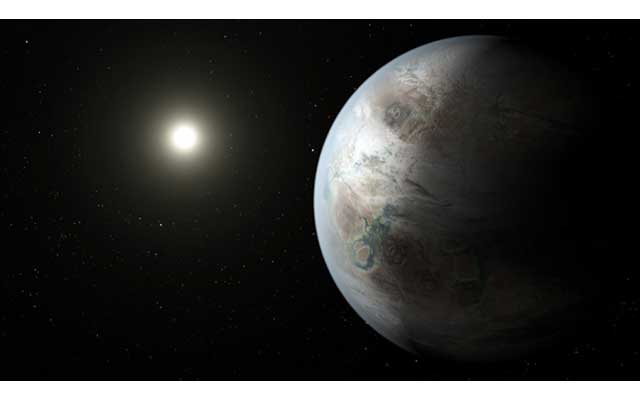
Astronomers discover a new branch in the family tree of exoplanets
The first exoplanet – a planet orbiting around a star other than the Sun – was discovered in the mid-1990s, and since then, astronomers have confirmed the existence of nearly 3,500 of them. One team of astronomers, including Lauren Weiss, a postdoctoral researcher at Université de Montréal's Institute for Research on Exoplanets, has looked in close detail at the 2,300 revealed by NASA's Kepler space mission and discovered that the most common ones in our galaxy are rocky Earth-like planets and larger mini-Neptunes.
The research – led by the California Institute of Technology (Caltech) with contributions from the University of California Berkeley, the University of Hawaii, Harvard University, Princeton University, and UdeM – took several years to complete and allowed the astronomers to obtain precise measurements of the sizes of the Kepler stars; these measurements, in turn, allowed the researchers to determine more precise sizes for the planets orbiting those stars.
They were able to measure the sizes of the 2,000 planets with four times more precision than had been achieved previously. In essence, their research shows that our galaxy has a strong preference for two types of planets: rocky planets up to 1.75 times the size of Earth, and gas-enshrouded mini-Neptune worlds, which are from 2 to 3.5 times the size of Earth (or somewhat smaller than Neptune)
“This is a major new division in the family tree of planets, analogous to discovering that mammals and lizards are distinct branches on the tree of life,” said Andrew Howard, professor of astronomy at Caltech and a principal investigator of the new research.
When a planet forms, its rocky core is at first made up of small rocks and pebbles. The gravity of the planet then attracts hydrogen and helium gas, after which the planet is “baked” by starlight and loses some gas. At a certain mass threshold, the planet retains the gas and becomes a gaseous mini-Neptune; below this threshold, the planet loses all its gas, becoming a rocky super-Earth. Our galaxy rarely makes planets with sizes in between these two. In the future, the Caltech-led researchers plan to study the heavy-element content of exoplanets to learn more about their composition.
Support Our Journalism
We cannot do without you.. your contribution supports unbiased journalism
IBNS is not driven by any ism- not wokeism, not racism, not skewed secularism, not hyper right-wing or left liberal ideals, nor by any hardline religious beliefs or hyper nationalism. We want to serve you good old objective news, as they are. We do not judge or preach. We let people decide for themselves. We only try to present factual and well-sourced news.
Support objective journalism for a small contribution.


