A space spider watches over young stars
The Spider, officially named IC 417, lies near a much smaller object called NGC 1931, not pictured in the image.
Together, the two are called"The Spider and the Fly" nebulae. Nebulae are clouds of interstellar gas and dust where stars can form.
The Spider, located about 10,000 light-years from Earth in the constellation Auriga, is clearly a site of star formation. It resides in the outer part of the Milky Way, almost exactly in the opposite direction from the galactic center. A group of students, teachers and scientists focused their attention on this region as part of the NASA/IPAC Teacher Archive Research Program (NITARP) in 2015. They worked on identifying new stars in this area, read the NASA website.
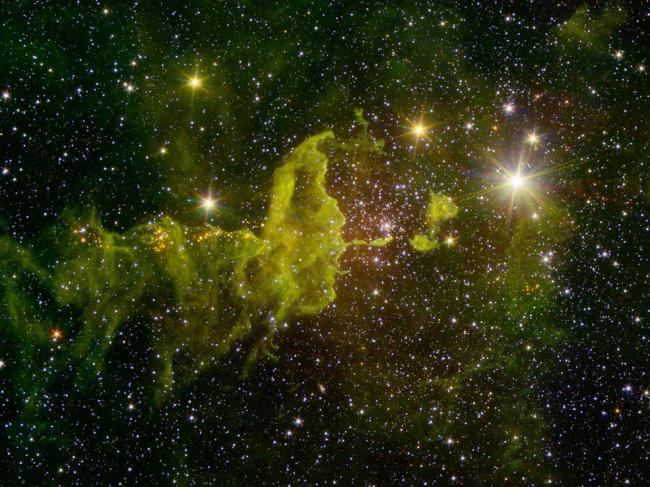
One of the largest clusters of young stars in the Spider can be seen easily in the image. Toward the right of center, against the black background of space, you can see a bright group of stars called "Stock 8."
The light from this cluster carves out a bowl in the nearby dust clouds, seen in the imageas green fluff. Along the sinuous tail in the center, and to the left, the groupings of red point sources clumped in the green are also young stars.
In the image, infrared wavelengths, which are invisible to the unaided eye, have been assigned visible colors. Light with a wavelength of 1.2 microns, detected by 2MASS, is shown in blue. The Spitzer wavelengths of 3.6 and 4.5 microns are green and red, respectively.
Spitzer data used to create the image were obtained during the space telescope's "warm mission" phase, following its depletion of coolant in mid-2009. Due to its design, Spitzer remains cold enough to operate efficiently at two channels of infrared light. It is now in its 12th year of operation since launch.
The 2MASS mission was a joint effort between the California Institute of Technology, Pasadena; the University of Massachusetts, Amherst; and NASA's Jet Propulsion Laboratory, Pasadena, California.
JPL manages the Spitzer Space Telescope mission for NASA's Science Mission Directorate, Washington. Science operations are conducted at the Spitzer Science Center at the California Institute of Technology in Pasadena. Spacecraft operations are based at Lockheed Martin Space Systems Company, Littleton, Colorado.
Data from 2MASS and Spitzer are archived at the Infrared Science Archive housed at the Infrared Processing and Analysis Center (IPAC) at Caltech. Caltech manages JPL for NASA.
Image Credits: NASA/JPL-Caltech/2MASS
Support Our Journalism
We cannot do without you.. your contribution supports unbiased journalism
IBNS is not driven by any ism- not wokeism, not racism, not skewed secularism, not hyper right-wing or left liberal ideals, nor by any hardline religious beliefs or hyper nationalism. We want to serve you good old objective news, as they are. We do not judge or preach. We let people decide for themselves. We only try to present factual and well-sourced news.
Support objective journalism for a small contribution.