


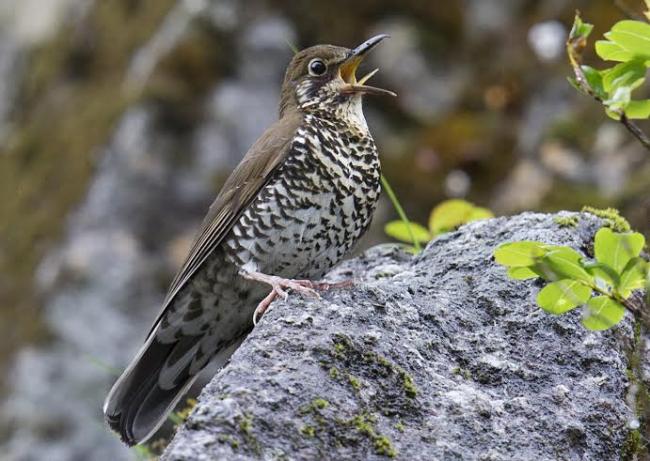
A common Himalayan bird identified as new species
Scientists have described this species from north-eastern India and adjacent parts of China as the Himalayan Forest Thrush.
New bird species are rarely discovered nowadays,with most natural habitats shrinking, said a press release from Mumbai-based BNHS-India. Since 2000, an average of five new species have been discovered globally every year, mostly from South America.
Himalayan Forest Thrush is only the fourth new bird species described from India since independence by modern ornithologists .
Commenting on the development, Dr Asad Rahmani, Senior Scientific Adviser and former Director, BNHS-India said, “It is a remarkable discovery and shows how much more we have to do in the field of ornithology in India. It also proves that north-eastern India is a treasure trove of biodiversity that needs protection from the mega projects that are planned in Arunachal Pradesh without giving any attention to biodiversity conservation.”
Dr Per Alström and Shashank Dalvi first discovered the species in May-June 2009 while studying birds at high elevations in western Arunachal Pradesh.
They realized that instead of a single species - Plain-backed Thrush (Zoothera mollissima) – as believed till now, in reality there existed two different species in eastern Himalaya.
Till now, the Himalayan Forest Thrush has been overlooked because of its close similarity in appearance to the Plain-backed Thrush, now renamed as Alpine Thrush.
Studies of specimens in 15 museums across seven countries revealed consistent differences in plumage and structure in the birds from the above two populations. It was confirmed that the species - Himalayan Forest Thrust - found to be breeding in the coniferous and mixed forests of eastern Himalaya was not separately classified till now.
What first caught the attention of the scientists was the fact that the birds found in forests (Himalayan Forest Thrush) had a rather musical song, whereas individuals found in the same region on bare rocky habitats above the tree-line (Alpine Thrush) had a much harsher, scratchier and unmusical song.
Further analyses of its plumage, structure, song, DNA and ecology throughout the range revealed that a third species was present in central China.
While this population was already known, it was treated as a subspecies of Plain-backed Thrush. It is now called Sichuan Forest Thrush, which has an even more musical song than that of Himalayan Forest Thrush.
A fourth species from China remains unnamed. Future field studies are required to confirm this, said the press release.
Image: Himalayan Forest Thrush, Pic: Craig Brelsford
Support Our Journalism
We cannot do without you.. your contribution supports unbiased journalism
IBNS is not driven by any ism- not wokeism, not racism, not skewed secularism, not hyper right-wing or left liberal ideals, nor by any hardline religious beliefs or hyper nationalism. We want to serve you good old objective news, as they are. We do not judge or preach. We let people decide for themselves. We only try to present factual and well-sourced news.
Support objective journalism for a small contribution.


