Why India won’t stop buying Russian oil, despite Trump’s tariffs: Report
India has made clear that it will not abandon Russian oil, even as President Donald Trump ratchets up pressure with punishing tariffs. For the world’s fastest-growing major economy and most populous country, energy security is non-negotiable, The New York Times reports.
Before the Ukraine war, Russian crude accounted for a sliver — just 0.2% — of India’s imports. Today, it supplies nearly half.
At more than 2 million barrels a day, Russian shipments have become central to powering India’s industries, transport, and households.
The lure is simple: cheap oil. Sanctions have cut Russia off from Western buyers, pushing it to offer discounts. India, a country that imports most of its fuel, seized the opportunity.
Oil firms have not only met domestic needs but also turned a profit by refining Russian crude and re-exporting products like diesel to Europe and beyond.
This trade is now worth over $130 billion annually. Energy giants such as Reliance, which operates the Jamnagar refinery — the largest in the world — have benefited handsomely.
For India, stepping away is not just about swapping suppliers; it would mean rewriting refinery systems, absorbing higher costs, and slowing down growth.
In short: politically and economically, walking away from Russian oil is not an option.
Tariffs bite, but won’t bend India
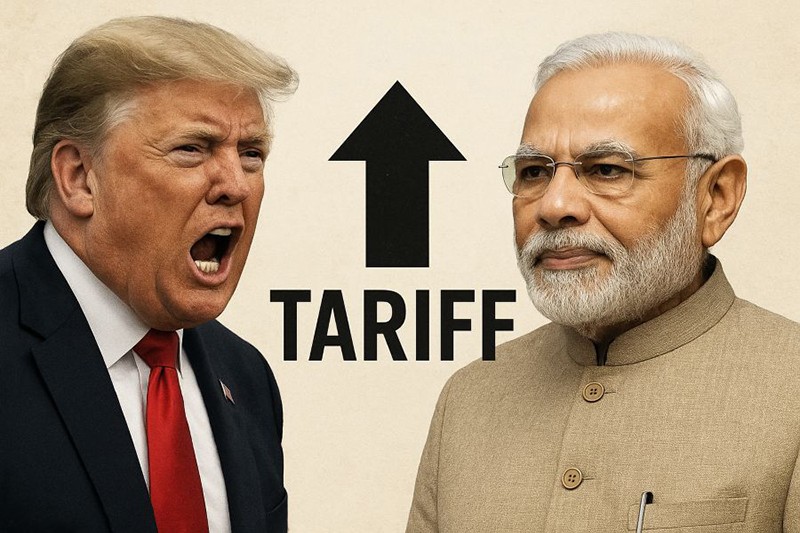
On Aug. 6, Trump issued an executive order slapping an additional 25% tariff on Indian imports — punishment, he said, for New Delhi’s refusal to halt Russian purchases.
Combined with an earlier 25% levy, Indian goods now face tariffs as high as 50% entering the U.S., steeper than those aimed at any other major economy.
India calls the measures “outrageous and unwarranted.”
While the tariffs sting, officials argue they cannot dictate the nation’s energy strategy.
For New Delhi, access to affordable oil directly underpins its growth trajectory.
Trump’s fixation comes as the U.S. trade deficit with India stands at $44 billion.
But even steep tariffs may not sway India to break ties with Moscow — especially as China, the only buyer bigger than India, continues to expand trade with Russia without facing similar U.S. punishment.
Trump’s lone punching bag
Trump has repeatedly castigated India on social media, calling it “Russia’s largest buyer of ENERGY, along with China, at a time when everyone wants Russia to STOP THE KILLING IN UKRAINE.”
But while China’s imports dwarf India’s, the White House has avoided direct confrontation with Beijing, wary of destabilising already fraught U.S.-China relations.
That leaves India as the convenient target.
Kremlin officials, for their part, denounced Trump’s actions, with spokesman Dmitry Peskov calling it “illegal” to coerce other countries into cutting ties.
Yet Trump has tied the oil issue firmly into trade negotiations, ensuring India carries the weight of his attempt to weaken Russia’s war chest.
For New Delhi, the calculation is straightforward: it cannot allow its energy security — and by extension, its economic rise — to be collateral damage in Washington’s geopolitical struggle with Moscow.
Support Our Journalism
We cannot do without you.. your contribution supports unbiased journalism
IBNS is not driven by any ism- not wokeism, not racism, not skewed secularism, not hyper right-wing or left liberal ideals, nor by any hardline religious beliefs or hyper nationalism. We want to serve you good old objective news, as they are. We do not judge or preach. We let people decide for themselves. We only try to present factual and well-sourced news.
Support objective journalism for a small contribution.